
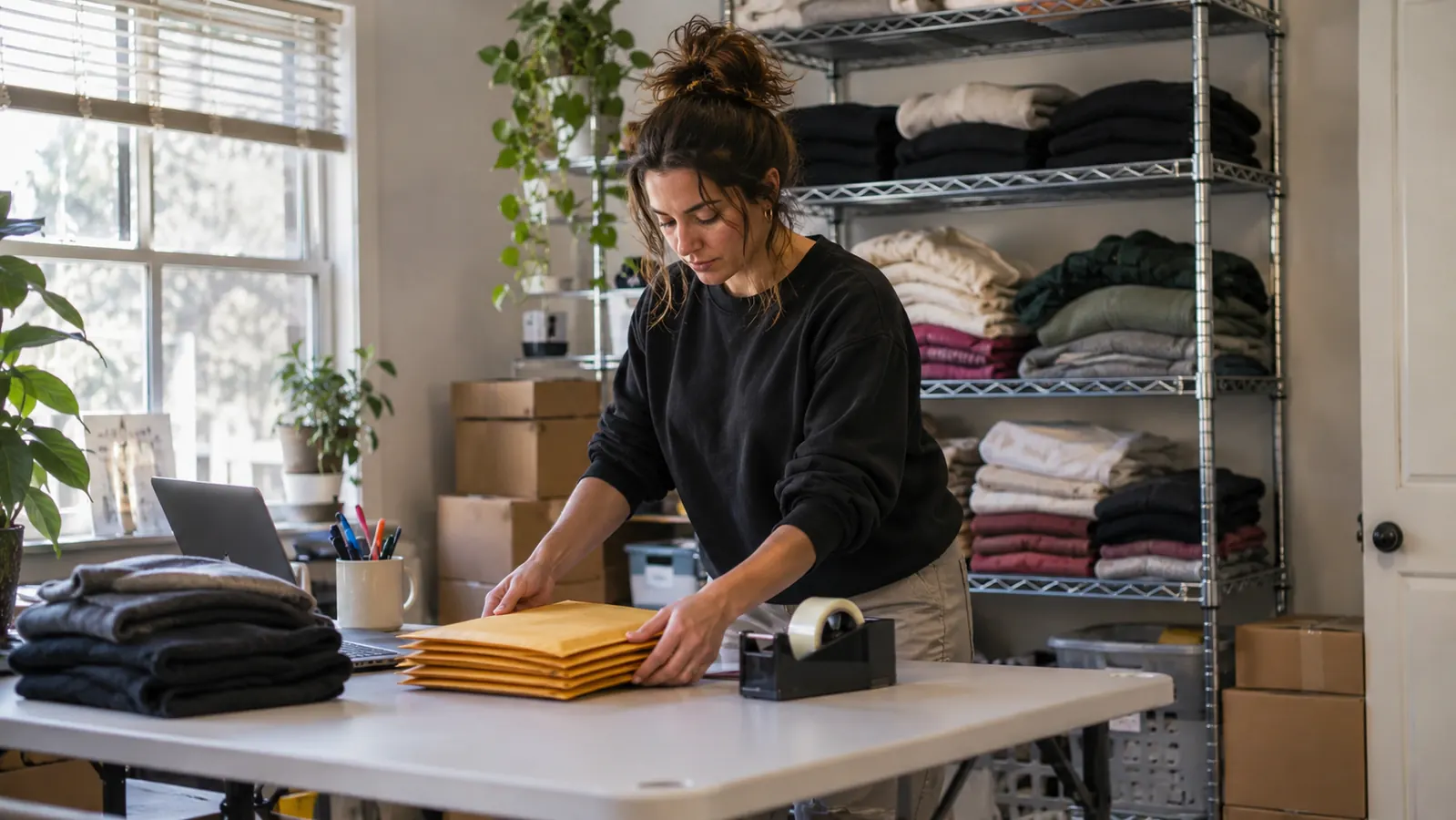
Poly mailers are the least interesting thing in my packing room and the item I run out of fastest. That room is the spare bedroom of my house in Dayton, Ohio, and it holds a folding table, wire shelving for inventory and a rolling cart that Gary takes out to the car most mornings. Anything that does not earn its space gets pushed off the table. So when I decided to try the METRONIC poly mailers in the 10x13, 100 pack size, they went straight into real orders instead of a test pile. Here is what I found, including the parts the product page does not spell out.
The short version first. These are good, plain, self-sealing bags, and they do the job for clothing and other soft goods. They are not a box. They will not protect a mug. And the 10x13 size is smaller in practice than the number suggests, which is the mistake I see new sellers make over and over. I go deeper on wear over months in my long-term Metronic poly mailers review, and I put them head to head with a pricier brand in the Metronic vs Fuxury comparison. This article is about the buying decision itself.
The Quick Verdict
Tough, light and self-sealing, and economical next to boxes. The flat shape and the tight 10x13 measurement are what decide whether they work for your orders.
Amazon Check Today's Price →The bag I reach for first on anything soft
Clothing, linens, paperback lots, anything that will not crack. Self-sealing adhesive strip, tear resistant, waterproof film, 100 to a pack so you are not reordering mid-week. Read the sizing note before you commit, because the measurement is the part that trips people up.
Amazon Check Today's Price on Amazon →What the Listing Does Not Tell You
Every poly mailer listing reads about the same. Waterproof, tear resistant, tamper proof, self-seal. Those words are accurate here, and the METRONIC listing carries them in the additional features section along with the material, which is polyethylene. What a listing cannot tell you is which of those qualities actually matter for the things you ship. Waterproof matters when a package sits on a porch in the rain. Tear resistant matters when the bag goes through a sorting machine. Tamper resistance matters when a buyer says the package arrived open. None of it helps you if the thing inside needed padding, because a bag does not pad.
The other thing nobody says out loud is that poly mailers are a category with very little difference between brands. The film is polyethylene, the closure is a self-seal adhesive strip, the bag is rectangular and flat. Where brands separate is film thickness, how hard the adhesive grabs, and whether the seams run straight. I have had a cheap bag split along a crooked seam before, and I have had one come open at the corner. It is not a complicated product, but it is not a place to buy blind either.
The 10x13 Measurement Is Not What You Think
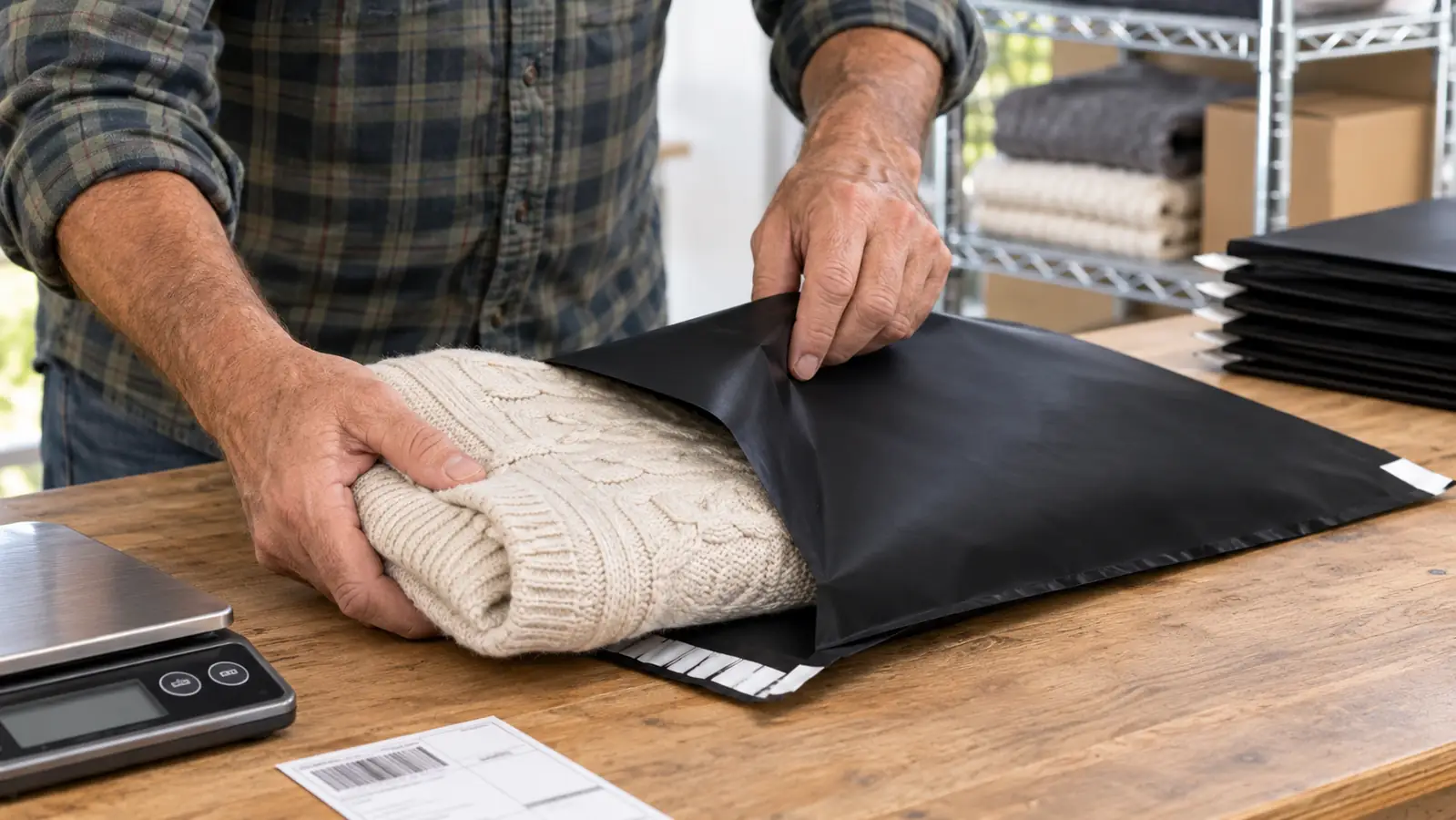
Ten by thirteen inches is the flat outside measurement. Usable space shrinks the moment you put something in, because the item takes up volume and the bag has to fold around it. A flat paperback slides in with room to spare. A folded pair of jeans goes in with a couple of inches left. A heavy sweater takes up most of it, and a bulky 2XL fleece will not close cleanly at all. I know because I tried, and I moved that order to a bigger mailer rather than force the flap down onto a strained seam.
This is where new sellers get burned. They picture a 10x13 bag and think about a 10x13 object, but the thickness of the item matters as much as the number. Something flat is easy. Something soft and fat fights you. My rule now is that if the folded item is thicker than about two inches, I reach for a larger mailer or a box. For a stack of tees, one sweatshirt, a pair of leggings or a paperback, the 10x13 is right and I do not have to think about it.
Books deserve their own note. A hardcover fits, but corners are the exposed part and poly film has no give at a corner. I wrap hardcovers in a layer of bubble wrap and then bag them, which costs maybe thirty seconds and has ended the corner ding complaints I used to get. A paperback alone in one of these is fine. Two paperbacks stacked is fine. Anything with a dust jacket that a buyer will inspect, wrap it first.
The Self-Seal Strip Is the Whole Product
The closure is an adhesive strip under a peel-off liner. You fold the flap, press, and the package is done. The listing calls the strip tamper resistant and that is fair, because it grabs hard and does not lift back up cleanly. Once it is down, it is down. That is good for security and bad for anyone careless about checking the item first. I have sealed a bag with the order still sitting on the table. Now I check contents twice before the liner comes off, because there is no second chance in the same spot.
Pressing matters more than people expect. If you fold the flap and give it one swipe, the ends can lift in handling. I run my thumb along the whole seam, corner to corner, then press the bag flat on the table for a second. Five seconds of work, and I have not had one come open since I started doing it. I also keep the pack indoors in the packing room rather than out in the garage, because a cold adhesive strip is not something I want to argue with in January. That is habit, not a defect claim.
Once that strip is down, it is down. I check twice before the liner comes off, because there is no second chance in the same spot.
What Six Weeks of Real Orders Showed Me
I ran these on eBay and Poshmark orders for six weeks, which for me is a bit over a hundred packages, plus a handful of Mercari sales. The film held. One bag arrived with a scuff and no tear, and nothing inside was damaged. I stopped double bagging clothing in the second week, because the bag was already doing what the second bag was supposed to do. That surprised me, since the double bagging was habit rather than a response to anything failing.
Waterproof mattered more than I expected, for a reason that was not rain at my end. I ship from Ohio and my drop-off is covered, but packages sit on porches. Two buyers messaged to say the package had been out in weather and the contents were dry. I do not take that as a promise for a downpour, and I still tape over the seam when the forecast looks bad. But the film does not soak through, and that is a real advantage over a paper envelope.
Two orders stand out from that stretch. The first was a three-book lot, two paperbacks and a hardcover, wrapped and bagged together, which arrived with the corners intact because of the bubble wrap and not because of the bag. The second was a pair of ankle boots, which fit fine and shipped for less than a box would have. Neither story is dramatic. That is the point. The bag did its job and I did not hear about that order again, which is exactly what I want from packaging.
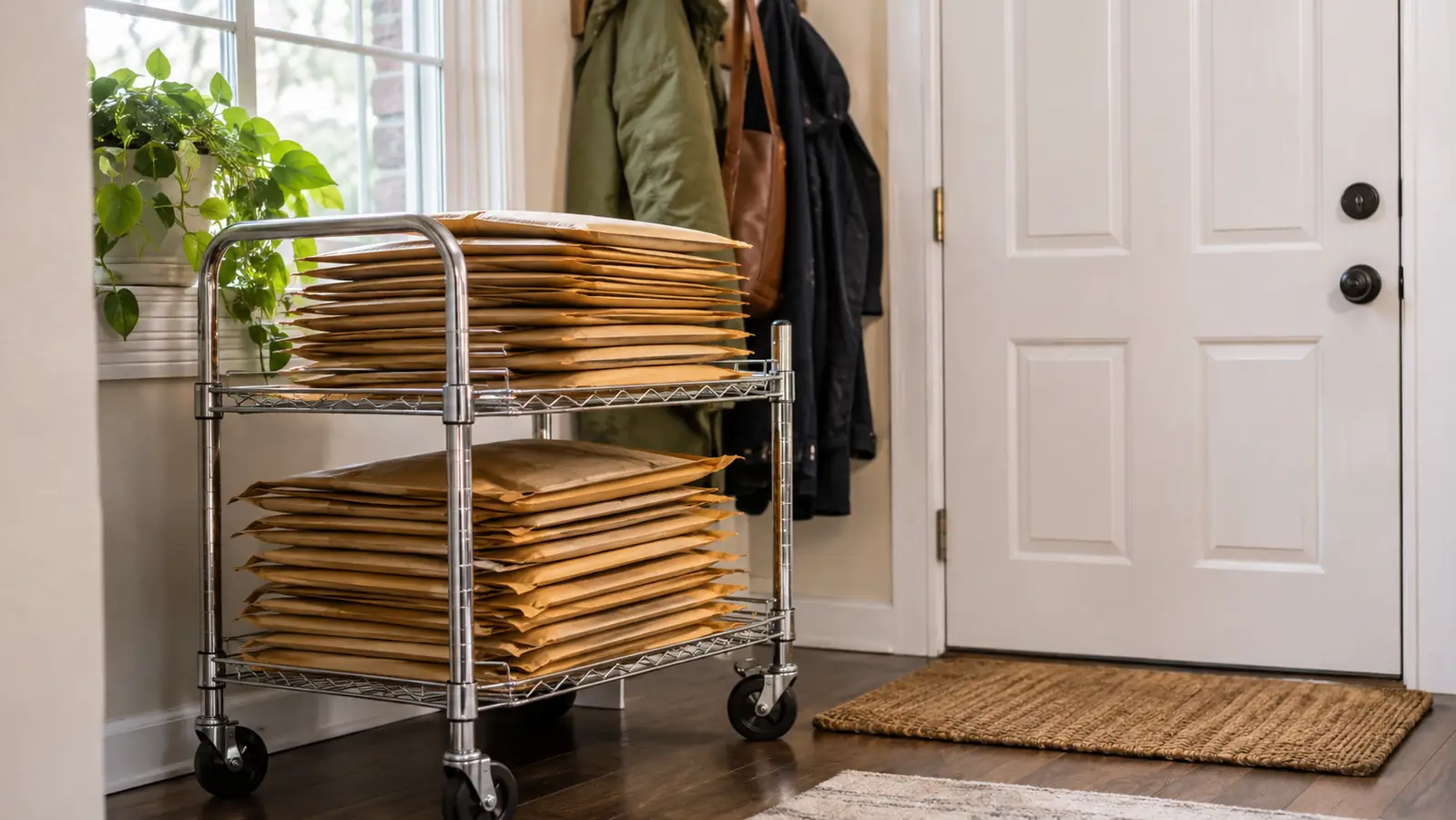
Weight is the quiet benefit. These are light, and on a clothing order the mailer barely registers on the label weight. That is not dramatic on any single package, but across a week of orders it keeps me out of the next weight tier more often than a box would. They also store flat. A hundred arrived compressed into a bundle about the size of a thick book, and they sit on the wire shelving without costing me a shelf that inventory needs.
Labels were my other worry, since a label that peels off in transit is a package that comes back to me. My printed adhesive labels stuck to the film without any fuss, and I did not need to tape over them, though I tape the seam anyway when the weather looks ugly. The one thing I would tell anyone is to keep the film clean before the label goes on. Dust and handling grime are the enemy of anything adhesive, and the listing calls these dust resistant, which is about the film, not about crumbs on your table.
What I Compared Them To
I keep four things on the packing table and I choose between them in about two seconds. A box for anything breakable. A bubble mailer for anything that needs cushioning but not structure. A rigid mailer for photos and comics, because a bend in transit ruins them. And a poly mailer for anything soft. The METRONIC bags won the soft category on the strength of the seal and the economy of a hundred to a pack, and they lost nothing I cared about, since a soft item does not need structure.
Against a paper envelope, the difference is night and day in the rain, and the poly bag is lighter for the same protection. Against a box, the poly bag saves weight and space but gives up everything rigid. Against a bubble mailer, it saves weight and bulk but gives up the cushioning. That is the whole decision tree, honestly. Most of my inventory is clothing and books, so poly wins on volume of orders. If your inventory leans toward housewares, your mix will look different and that is fine.
The 100 count is the other thing worth thinking about before you commit to a size. For me it is roughly two months of mailers, which means I am not reordering mid-week and I am not storing a year of packaging either. If you ship a handful of orders a week, a hundred will last you a long time and take up almost no space on a shelf. If you ship thirty a week, you will be reordering sooner than you think, and that is worth knowing before you build your whole morning routine around one size.
What I Liked
- Self-seal adhesive strip grabs hard and stays down
- Waterproof polyethylene film kept contents dry on rainy porches
- Tear resistant enough that I stopped double bagging clothing
- Light enough to keep clothing orders in a lower weight tier
- 100 to a pack, so I am not reordering every week
- Stores flat and takes almost no shelf space
Where It Falls Short
- No padding and no rigidity, so anything breakable needs a box
- 10x13 is tight for bulky sweaters and a heavy fleece
- Once the strip is sealed there is no reopening the same bag
- A flat bag distorts when overstuffed and puts strain on the seam
- No structure at all, so photos and comics need a rigid mailer
The Annoying Parts
The biggest annoyance is that these bags tempt you into using them for things they cannot protect. It is fast, it is right there, and it makes the order feel finished. Then a ceramic piece arrives cracked and you are out the item and the shipping both. I keep a small stock of boxes and a roll of bubble wrap within arm's reach for exactly that reason. If the item can break, chip, bend or crease, the bag is the wrong tool and no amount of extra tape changes that.
Second annoyance is overstuffing. Because the bag is flat, a fat item turns it into a pillow and puts pressure on the seam and the corners of the film. I have not had one split on me, but I have had one arrive looking strained, and I would rather not repeat it. If I have to press down on the flap to get it to meet the strip, that is my signal the item belongs in the next size up. Third is the liner. Peeling it on a bag lying flat on a table is easy. Peeling it while holding a bag open with one hand and a sweater with the other is not. I line everything up first now.
One more small thing, and it is genuinely small. You will not need a tape gun for these, which is the point, but you will want scissors or a letter opener within reach for the liner on a stubborn pack, and you will want a flat surface. Packing on the couch with a bag balanced on your knee is how you end up with a crooked seal and a wrinkle pressed into the film. The table matters. I learned that the slow way, over a hundred packages and a few that I would not want a buyer to open on camera.
Who This Is For
This is for the seller whose orders are mostly soft. Clothing, leggings, tees, scarves, linens, pillow covers, tote bags, plush toys and paperback lots. It is for the person listing on eBay and Poshmark who packs at a kitchen table or in a spare room and wants one less decision in the morning. It is also for anyone losing money to shipping weight on clothing orders, since a light bag helps there with no other change to the routine. If that describes your inventory, the METRONIC 10x13 pack does the job and you will stop thinking about it.
Who Should Skip It
Skip these if your inventory is fragile or boxed. Mugs, ceramics, glassware, framed art, electronics, anything with a hard corner a buyer will inspect on arrival. Skip them if you sell comics, photos or prints, which want a rigid mailer that will not bend. Skip them if you sell heavy items the bag has to strain around. And skip them if you want a branded unboxing, because a plain poly bag is a plain poly bag. There is nothing wrong with that, but no customer is going to photograph it.
One less decision at the packing table every morning
100 self-sealing mailers that hold up on soft goods orders. Check the current price and the size chart before you buy, because the measurement is the part that trips people up, not the bag.
Amazon Check Today's Price on Amazon →The last thing I will say is that the size decision matters more than the brand decision. Buy a small pack in two sizes if you can and see which one your actual orders need. I keep 10x13 for the bulk of my clothing and a larger size for sweaters and multi-item lots, and that pair covers nearly everything that comes off my table. The bags are good. Your order mix is what decides whether they are good for you.