
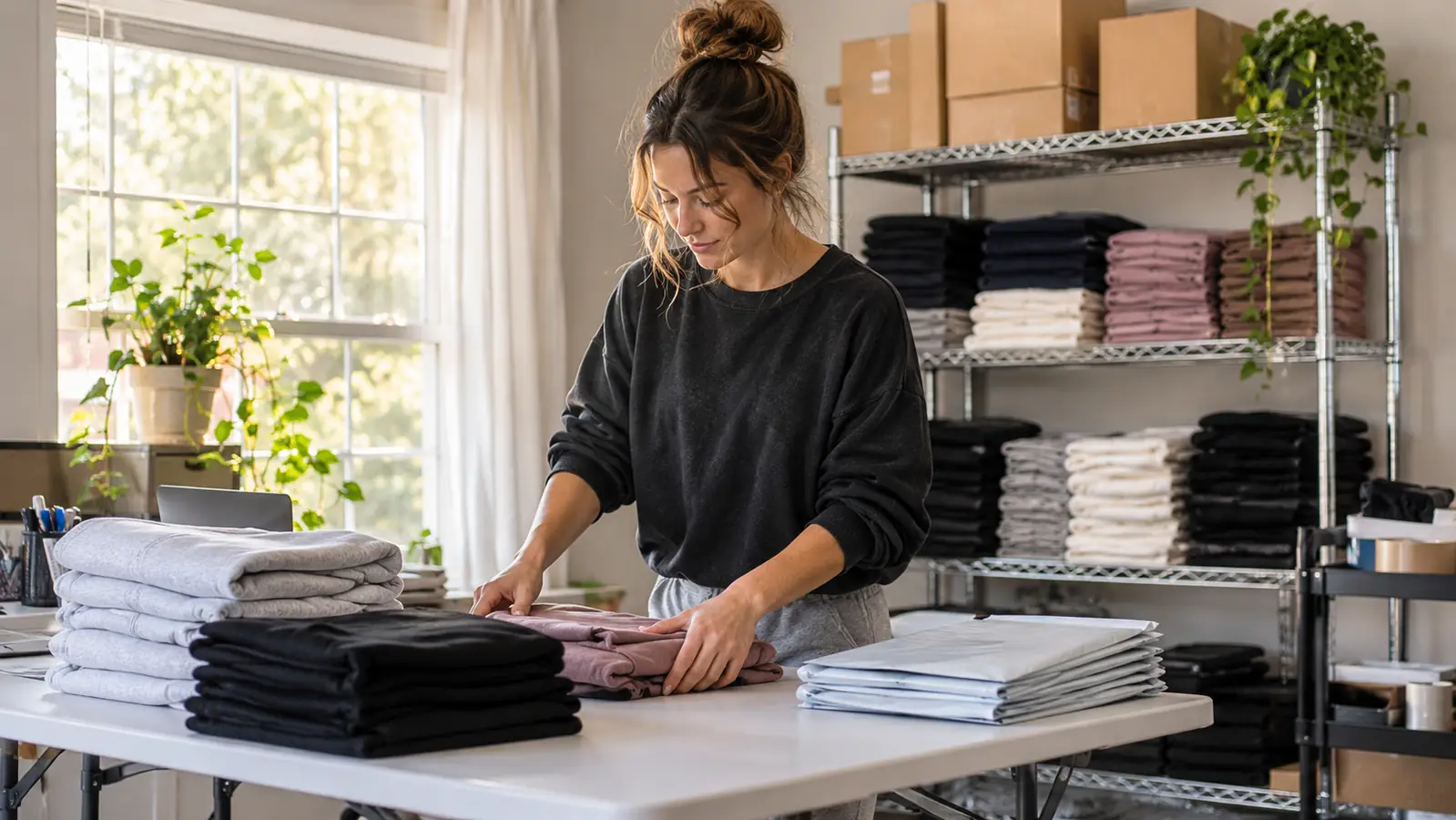
The first clothing order I ever shipped went out in a corrugated box that weighed more than the sweater folded inside it. I had run out of mailers, I was already late for the post office, and I grabbed the first thing on the shelf. The buyer left four stars and a comment about the shipping charge. That was six years ago, and it is the reason I went looking for something lighter. I landed on METRONIC Poly Mailers in the 10x13 size. I have now sealed, labeled and dropped off somewhere past 1,000 of them from the spare bedroom I use as a packing room.
What follows is not a hype piece. It is what I noticed across ten 100-count packs of these mailers, used mostly for thrifted clothing on eBay and Poshmark, with some Mercari and a few soft housewares mixed in. If you sell clothing and you are tired of paying for boxes, this is the honest version, including the parts I would change if I could.
The Quick Verdict
Light enough to keep postage down, waterproof in real weather, and the self-seal strip holds. Not the mailer for anything with a hard corner.
Amazon Check Today's Price →The mailer I have reordered ten times
10x13 inches, self-seal adhesive strip, waterproof polyethylene, 100 to a pack. It has carried most of my clothing orders for six years.
Amazon Check Today's Price on Amazon →How I've Used It
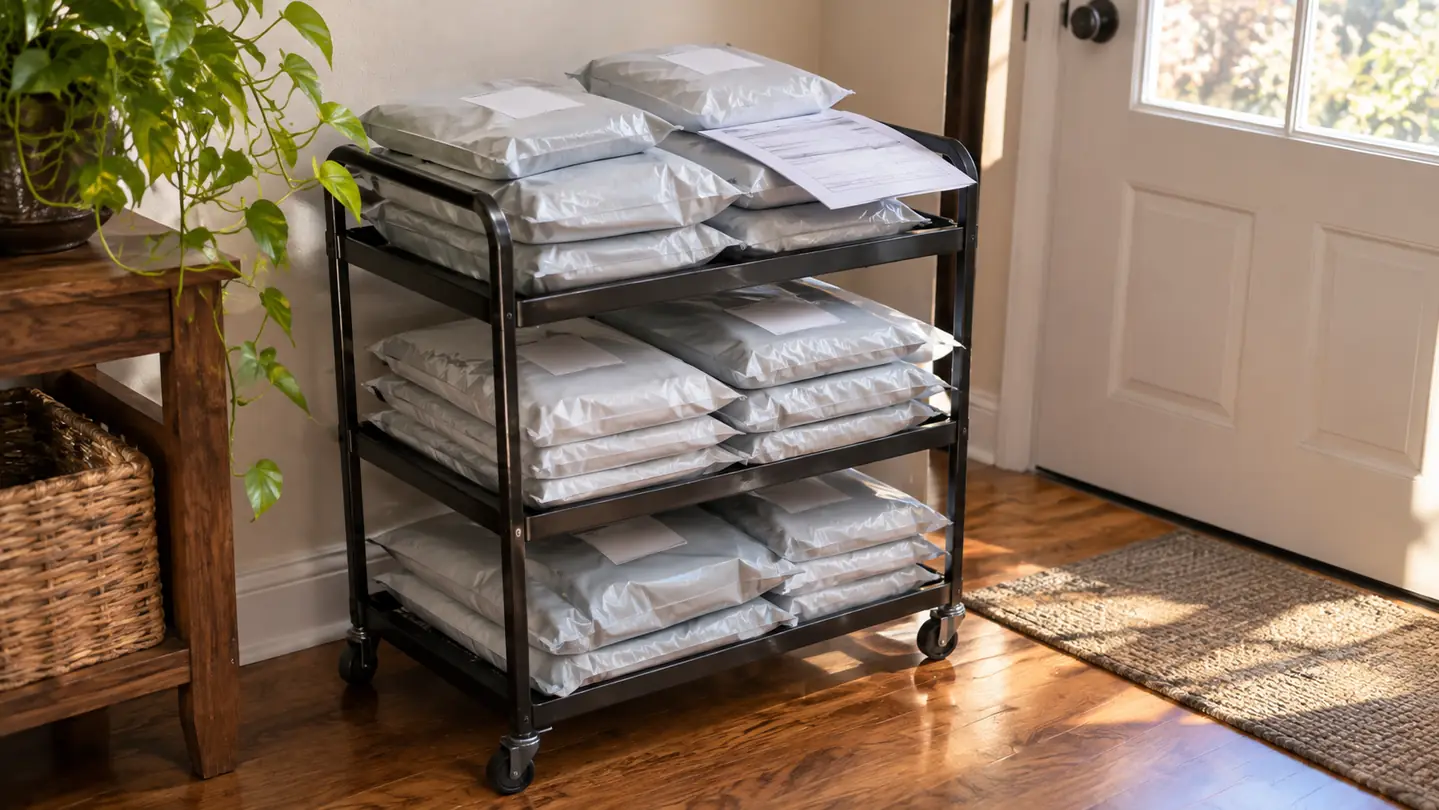
My week runs the same way most weeks. I source on Saturdays at thrift stores and estate sales, I list in the evenings, and I pack and ship on weekday mornings before the heat builds. The packing happens on a folding table in the spare bedroom, with wire shelving behind me for inventory and a rolling cart by the door for whatever is leaving that day. Gary carries the full cart down to the car and drives it to the drop-off. Everything in between is mine.
A normal morning is eight to fifteen packages. Most are clothing: a blouse, a pair of jeans, a sweatshirt, sometimes a bundle of three or four pieces that sold together. I fold, I slide the item into the mailer, I peel the liner off the adhesive strip, I press the seam flat, and I write the order number on the corner in marker before I print the label. That last step has saved me more than once when two packages looked alike on the cart.
Over six years I have gone through ten 100-count packs of METRONIC mailers. I have had three arrive with a problem, either a strip that had gone tacky in storage or a corner fused shut. Three out of a thousand is a rate I can work with, and I have not found a brand in the same size that does better for what I am doing with them.
The 10x13 size handled roughly 80 percent of what I ship. The rest either needed the next size up or went into a box because the item had a hard edge. Knowing which 20 percent needs the box took me a full year to learn, and the short version is that anything that can crack gets a box and anything that can only crease gets a mailer. I keep a running tally on the whiteboard by the shelf, mostly so I stop guessing when it is time to reorder. Last month it read 62 orders: 49 of them in a 10x13, nine in a larger poly bag for a coat and a bundle of denim, and four in boxes for a set of stoneware mugs and three picture frames. That ratio has held steady for two years, which is why I buy this size and not the next one up.
What 10x13 Inches Actually Holds
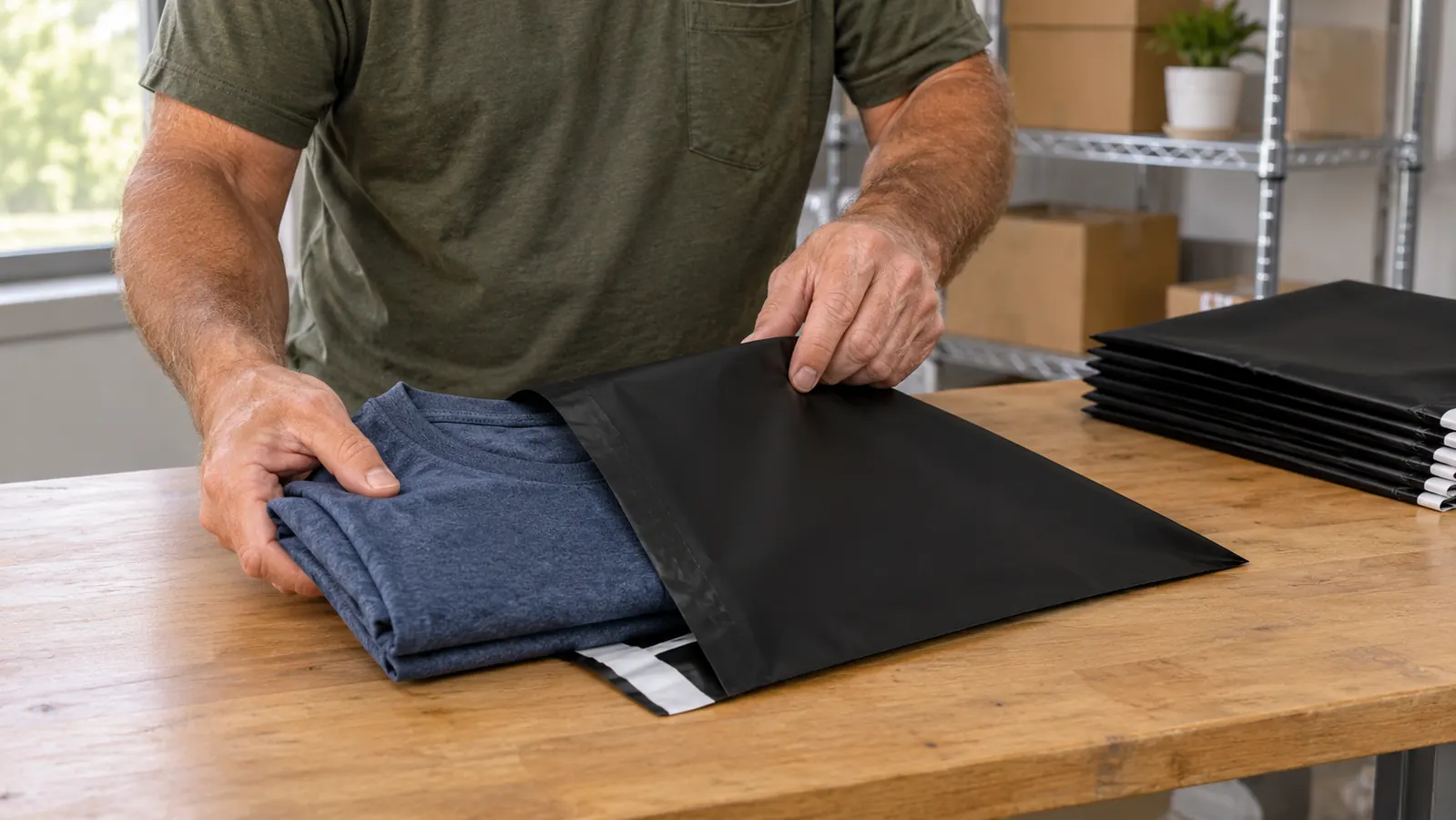
Numbers on a listing page are abstract until you are standing at the table with a garment in your hand. Here is what fits in a 10x13 without a fight: a folded button-down shirt, a t-shirt folded in thirds, a lightweight sweater, a pair of jeans rolled once, two t-shirts stacked, a skirt, a dress that is not too long, a set of cloth napkins, a paperback.
Here is what does not fit, or fits badly: a folded winter coat, a pair of boots, a stack of denim jackets, anything with a rigid corner. A book will physically slide into a 10x13, and I stopped doing it. The mailer holds fine and the corners of the book still get dented somewhere in the system, and I would rather pay for a box than issue a partial refund over a bashed corner.
Depth matters as much as footprint. These are flat bags, so a bulky item turns the mailer into a pillow and the seal has to fight the pressure from inside. A sweater packed loose is fine. A sweater crammed in so the seam bulges is not. I learned that in my second month, when a buyer sent me a photo of a seam that had started to peel from the middle outward.
One folding habit worth stealing: fold the garment to a size slightly narrower than the mailer, then slide it in flat instead of pushing it down into the bag. It takes four extra seconds and the package ends up square, which matters when you are stacking twelve of them on a cart and the labels need to stay face up.
The Self-Seal Strip After a Thousand Seals
The closure is a peel-and-press adhesive strip. No tape, no water, no heat. You fold the flap down, press along the length, and if you have done it right, it stays. I press with the heel of my hand and then run my thumb across the full width, corner to corner, because a seal pressed only in the middle is a seal that opens in a sorting facility.
It is tamper resistant in the way that actually matters to a buyer: once it is down, opening it means tearing the mailer. I have never had a buyer tell me a package arrived looking resealed. I have had two arrive split, and both were packed too full, with the contents pushing against the seam from the inside. That was my packing, not the mailer.
One thing to know before you buy a pack. The adhesive grabs on contact. If you set the flap down crooked, you are not lifting it back up without tearing the top edge. Line the edge up before you commit. On a busy morning with twelve packages on the table, this is where mistakes happen, and the fix is to seal one package at a time instead of lining up three at once and hoping.
I learned that on a Tuesday in March with eleven packages on the table and the car already running. I lined up three mailers, sealed the middle one straight, and set the flap of the first one down about a quarter inch off. It stuck exactly where it landed. I ended up folding the corner over and taping it, which defeated the whole point of buying a mailer with a strip, and that package was the ugliest thing I sent that week. Now the roll of tape stays in the drawer unless something has genuinely gone wrong, and I seal them one at a time, in order, left to right.
Waterproof and Tear Resistant, in Real Weather
These are polyethylene, and that is the whole reason I use them for clothing. Rain does not soak through. Snow does not soak through. A package that sits on a wet porch for four hours comes inside with dry contents. I have shipped through two Ohio winters and one very wet spring, and I have not had a single water-damaged order.
The spring I am thinking of was a stretch in April when it rained four days out of six and the mail carrier stacked everything on the open porch instead of tucking it under the eaves. Nine packages went out in that run, all clothing, all in these mailers. Every one of them came out dry. I had two book orders in the same batch in plain cardboard, and both of those came back to me looking like they had been left in a gutter.
Tear resistance is a different claim and it deserves a straight answer. The material shrugs off a snag and it survives a conveyor belt. It does not survive a box cutter. If a buyer opens their mailer with a blade and cuts through the garment, that is not the mailer failing, and I have still replaced a shirt over it. I now put a line in my packing slip asking people to open with scissors, away from the item. That cut the problem down without eliminating it.
Weight matters more than people expect. A poly mailer adds almost nothing to the package. A corrugated box adds ounces, ounces change what a buyer is charged at checkout, and that changes whether they buy at all. That was the original reason I switched. A thousand orders later, it is still the reason I stay.
Two Ohio winters, one very wet spring, and not a single water-damaged order.
Where They Fall Short
The list is short but it is real. Presentation is the first item. A poly mailer is a bag. If you sell higher-end clothing and the unboxing is part of what the buyer is paying for, a bag will not deliver that. I sell thrifted clothing at thrifted prices, so a bag is fine, and I have never had a complaint about it.
Second, protection from crushing. A mailer protects against water and dirt and very little else. If a garment creases permanently, or has a stiff collar that will not recover, a box is the right call and I do not care how much faster the bag is.
Third, the count. A 100-count pack is a lot of mailers. If you ship six items a month, that pack sits on your shelf for a year and a half, and the adhesive does have a shelf life. I keep mine in the spare bedroom, away from heat and direct sun. The one METRONIC pack I stored in the garage over a summer gave me trouble with the strip, and I stopped storing them out there. I date the outside of the pack with a marker now, mostly so I can tell myself the truth about how long it has been sitting. The pack I opened in January had been on the shelf since the previous spring, and the first dozen seals peeled clean with no trouble at all. Heat was the problem with the garage pack. Age was not.
Fourth, and this is small but it annoys me every time: the label goes straight onto the face of the mailer. That is fine until a sale falls through and you want to reuse the bag, because peeling the label takes the surface with it. I keep a few spares set aside for the orders I suspect might come back.
How They Compare to the Boxes I Used Before
I packed in boxes for the first year and a half, mostly because that is what I had. Boxes are better at exactly one thing: protecting a rigid item. For clothing they cost me time in assembly, tape and void fill, and they cost the buyer weight. Every box I eliminated from a clothing order was a small win on both ends.
The tradeoff I did not expect was storage. A 100-count pack of mailers lays flat and slides under the table or stands on end on a shelf. A hundred boxes is a wall. In a spare bedroom with one shelving unit and a folding table, that difference decided it for me.
If you want the longer version of that argument, I wrote it up separately in 10 reasons poly mailers beat boxes for clothing. The short version is that for soft goods the mailer wins on time, on weight, and on the space it does not take up.
I also set these against a higher-priced mailer brand earlier this year, same table, same morning, and the difference came down to how aggressive the adhesive was and how the film felt in the hand. That comparison lives in METRONIC vs Fuxury poly mailers if you are weighing the two against each other.
What I Liked
- Waterproof polyethylene keeps clothing dry through rain, snow and a wet porch
- Self-seal adhesive strip means no tape, no dispenser and a faster morning
- Lightweight, so it does not add postage weight to a clothing order
- 10x13 holds a folded shirt, a pair of jeans or a light sweater without a fight
- Tamper resistant once sealed, which buyers notice and mention
Where It Falls Short
- No protection against crushing or bent corners
- Adhesive grabs on contact, so a crooked seal cannot be corrected
- A 100-count pack outlasts a light shipper, and the strip does age
- Not the right look for higher-end clothing where unboxing matters
Who This Is For
This is for the home seller who ships soft goods. Clothing, linens, small soft housewares, anything that will not be ruined by a crease. If 10x13 covers most of your orders, as it covers about 80 percent of mine, a 100-count pack is a sensible thing to keep on the shelf next to the printer.
It is also for anyone who has been taping up boxes for clothing and quietly resenting it. The switch takes one morning to get used to and then you stop thinking about it, which is the highest compliment I can pay a packing supply. Supplies should disappear into the routine. These did.
Who Should Skip It
Skip it if you sell anything rigid. Mugs, glass, ceramics, frames, hardcover books sold as collectibles, electronics. A mailer gives you no crush protection, and a buyer will not care that the bag itself held up fine while the contents did not.
Skip it if you ship fewer than a dozen items a month and have nowhere cool and dry to store a 100-count pack, because the adhesive will not wait for you. And skip it if unboxing is part of your brand. Some sellers are selling a presentation, and a bag is not a presentation.
Ten packs in, still the one I reorder
10x13 inches, self-seal adhesive strip, waterproof polyethylene, 100 to a pack. It has carried roughly 1,000 clothing orders out of a spare bedroom in Dayton.
Amazon Check Today's Price on Amazon →