
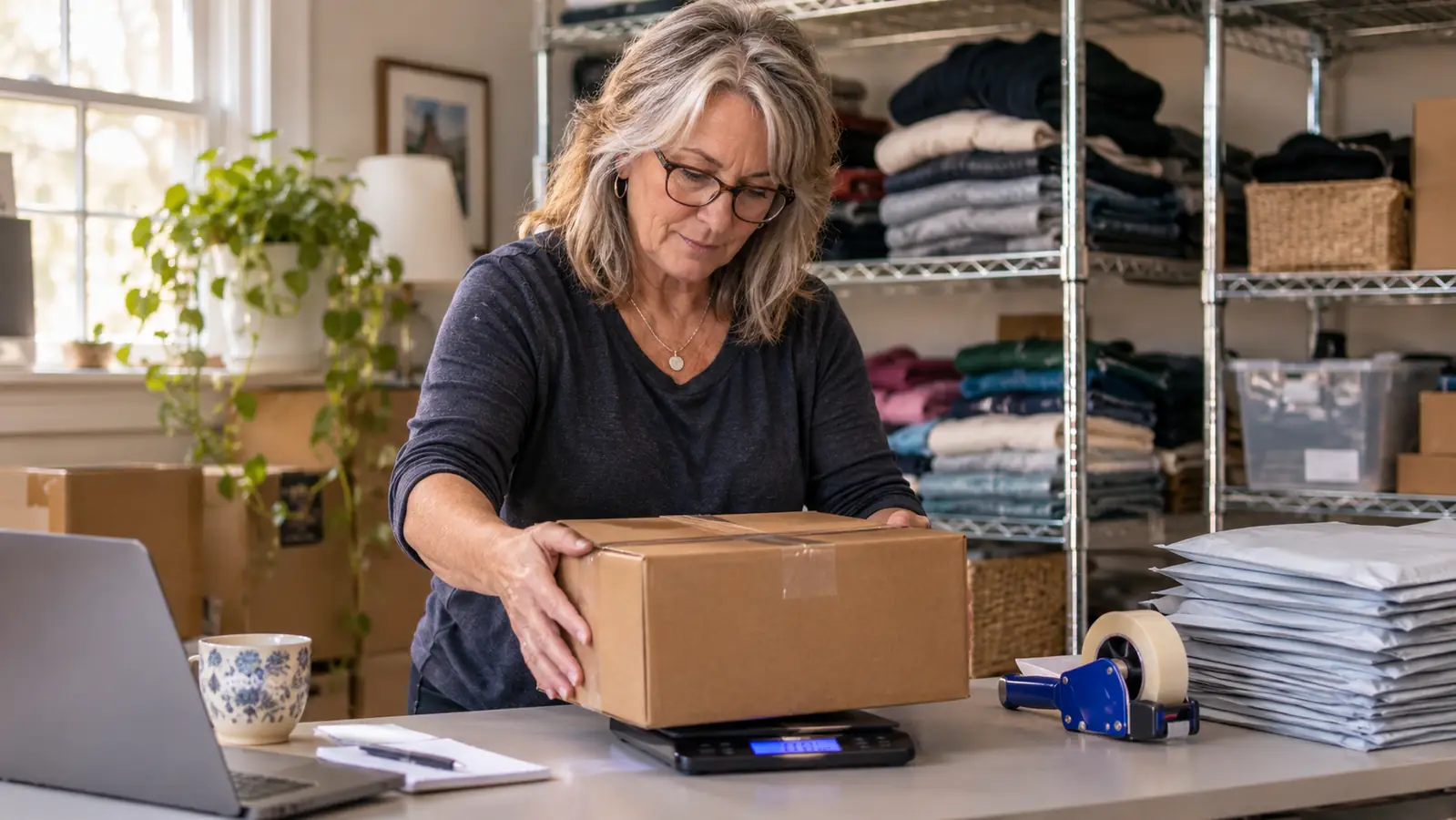
Three years ago I mailed a pair of jeans to a buyer in Oregon. Nine days later the package came back to me with a yellow sticker on it that said postage due. I had weighed it on my kitchen scale, the one I use for flour, and that scale read 1 pound 14 ounces. The counter scale at the post office read 2 pounds 2 ounces. Four ounces, and I lost the sale, paid the return postage, and spent twenty minutes on hold to find out why.
Here is the part that took me embarrassingly long to understand. A kitchen scale is built for things that sit still and stay small. Shipping is neither. A box overhangs a two inch platform, a poly mailer drapes off the edge, and the number drifts while the contents settle. ACCUTECK solves the shape problem with a flat platform that takes a whole box and holds up to 50 pounds, and once I set one on the wire shelving next to my tape gun, the yellow stickers stopped. What follows is the routine I use now, in order, most mornings in the spare bedroom I turned into a packing room.
Weigh it once, before the buyer's label goes on
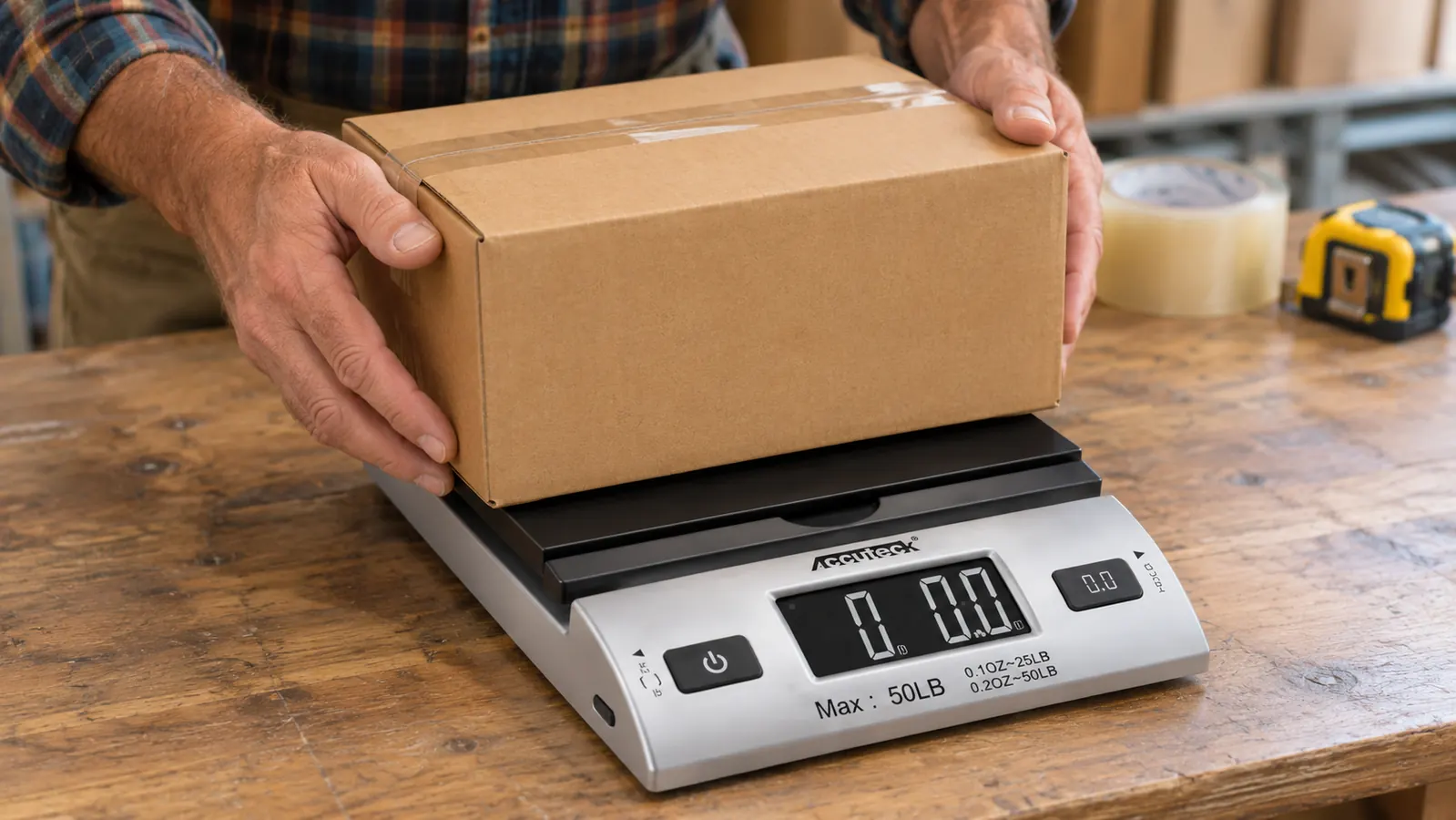
A flat platform that holds the whole box, readings to 0.1 oz, and a hold function for boxes you cannot see around. That is the whole job. Runs on the included AC adapter or on AAA batteries.
Amazon Check Today's Price on Amazon →Step 1: Put the scale on something hard, and make it start from zero
Carpet will ruin your reading and it will ruin it quietly. The folding table in my packing room is fine. The rug under that table is not. If the scale rocks even slightly when you press a corner, the mechanism underneath is fighting the surface, and the number you get will be off by an ounce or more without ever looking wrong. Set it on a hard, level surface and press down once with your palm to settle it.
I tried a shortcut first, because of course I did. I slid a wooden cutting board under the scale and set the whole thing on the rug, thinking the board would spread the weight out and everything would be fine. It was not fine. The board rocked on the pile and the scale rocked with it, and I bought a label for a wool sweater at 12 ounces when the sweater was closer to 15. Hard floor, bare table, nothing soft underneath. That has been the rule ever since.
Then turn it on and watch for the zero before anything goes on the platform. Mine runs its startup and settles at 0.0. If it does not settle at zero, lift it, set it back down, and give it a few seconds. Auto shut off will blank the display if you wander off to find tape, so when you come back, tap the platform, wait for zero again, and do not trust a reading that was sitting on the screen from before.
The platform folds up, which matters more than it sounds in a room where the spare bed is now wire shelving. When I finish for the morning I fold it flat and stand it on end between the shelf uprights, out of the way of the box of books I am always dragging past. A scale that lives underfoot gets kicked, and a kicked scale is a scale you stop believing.
Step 2: Weigh the empty box first and write the number down
Every corrugated box has weight of its own. It is usually small, a few ounces, and it is the number almost everyone skips because it feels like busywork. Skip it and you build the same small error into every shipment that goes out in that box size, every week, for as long as you keep buying that size.
I keep a spiral notebook on the shelf and write three things for each box: the size, the empty weight, and the packed weight. After a few weeks I stopped weighing empty boxes for the four sizes I use most, because the number was already written down. That is maybe two minutes saved per morning and, more to the point, one less place for me to guess.
Books are the worst offenders for guessing. A single hardback runs around a pound and a half, and a lot of five weighs more than people expect. For two years I estimated lot weights by feel, added a little for padding, and found out at the counter that I had guessed low again. Now I set the padded envelope on the platform on its own, drop the five books in, and read the actual number off the display. The same five books weigh the same every time, so once it is written down I never weigh that lot twice.
This is also where the tare function on the ACCUTECK earns its keep. If you are weighing loose contents instead of a box, set an empty bin or a mailer on the platform, press tare, and the display drops back to zero so you are weighing only what is inside. I use it most for lots of books and for anything going out in a padded envelope, where the envelope weight is not worth tracking separately but the contents weight absolutely is.
Step 3: Pack it fully, then weigh the finished box
Weigh the thing the way the carrier will see it. Tape on. Padding in. Label on. A wad of kraft paper is real weight, and three wads of it is real weight three times. I learned this the slow way with a box of stoneware mugs, which I had weighed before I wrapped anything, and which then went out at nearly a pound more than I had paid for.
That mug box still bothers me, so here it is in full. Four mugs, each one wrapped in paper, double boxed with more paper between the layers. On their own the four mugs settled at just over 3 pounds. Sealed and ready to go, the same set was 3 pounds 15 ounces, and I had bought a label at 3 pounds. The mugs arrived fine. The label did not, and I ate the difference and the phone call.
Long boxes are where the ACCUTECK hold function matters. On a box that is wider than the platform you cannot see the display while you are squaring it up, so you press hold once the number stops bouncing and it stays on the screen while you set the box down and read it. Mine reads in kilograms, pounds and ounces, or plain ounces. I stay in pounds and ounces because that is what my listings and my carrier forms use, and switching units mid-morning is how you type 3 pounds 2 ounces into a field that wanted ounces.
The backlit display sounds like a small thing until you are packing at seven in the evening in a room with one lamp. I do most of my shipping in the morning, but the listings happen at night, and the number is readable either way without me leaning over the platform with a flashlight.
Step 4: Round up, then measure the box
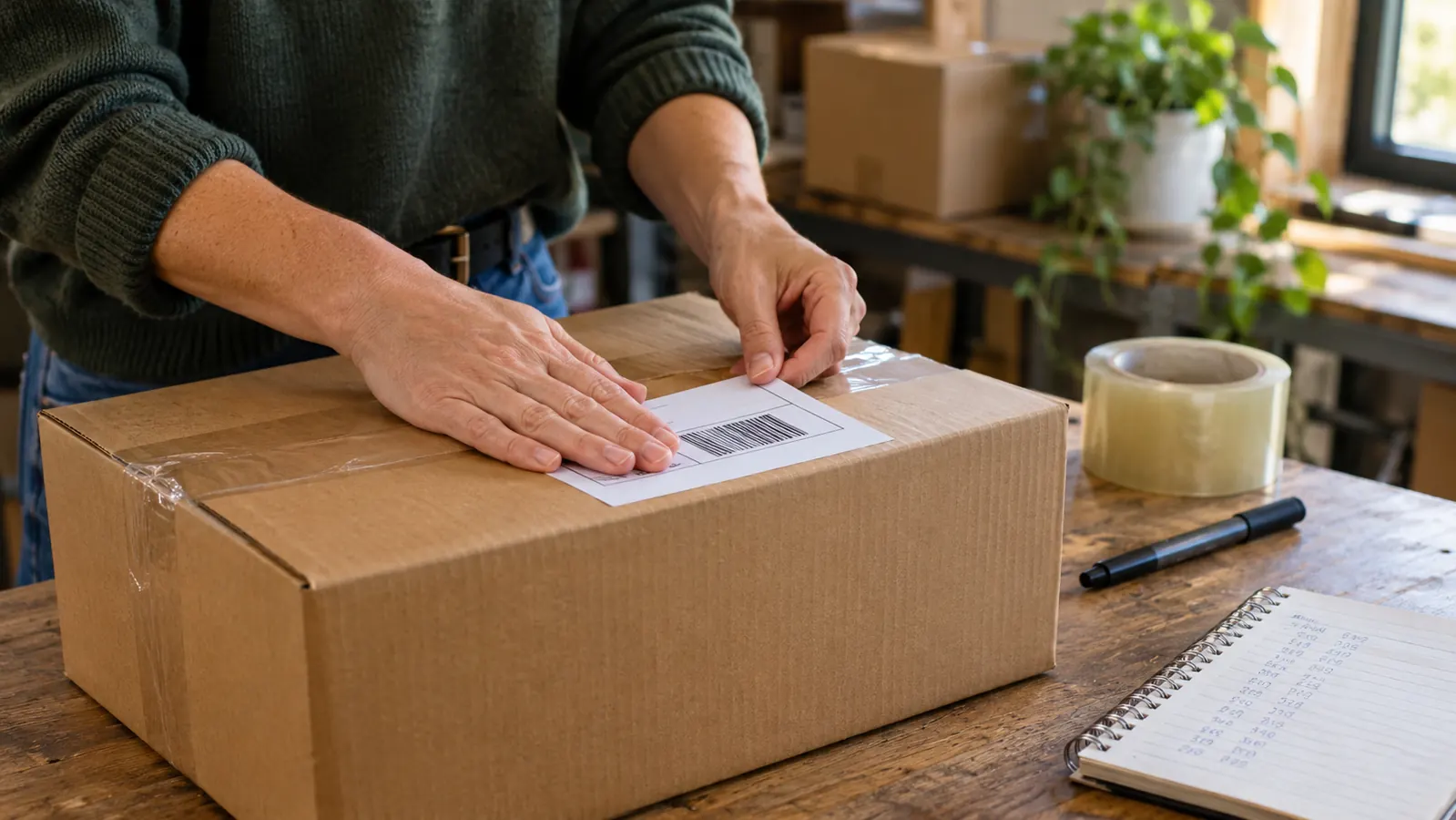
Carriers round. They do not bill you for 1 pound 3.4 ounces. They bill for the next ounce up, and often the next pound up depending on the service. So round up before you buy the label, not after. I add the rounding in my head as I write the number down, and I have not had a postage due return since I started doing it.
Then get the tape measure out, because weight is only half of what you are being charged for. A large, light box can price off its dimensions rather than its actual weight, and no scale on earth will tell you that. I keep a tape measure clipped to the shelf upright and check the carrier's own page for the divisor rather than trusting a rule of thumb from a forum post written in 2016. Ten seconds of measuring has caught two boxes for me this year, both of them long and both of them clothing stuffed into a big carton because I had run out of the smaller size on a Sunday.
The 50 pound capacity covers everything I ship and then some. My heaviest regular outgoing package is a flat rate box of hardbacks that runs around 22 pounds, and my husband Gary carries those to the post office drop off because I had back surgery in 2021 and I am not proving anything to anybody. The point is that the scale is not the limiting factor in my packing room. My own shoulders are, and I would rather know that than guess at it.
Step 5: Re-weigh after you seal it, and keep a log
The mistake I make now is not the scale. It is me. I weigh a box, remember the number, then decide one more item would fit, add it, and buy the label from memory. Two Tuesdays ago I did exactly that with a stack of paperback mysteries, talked myself into one more book, and only caught it because I set the sealed box back on the platform and it read 4 pounds 6 ounces against the 4 pounds 1 ounce in my head. So the rule in my house is simple: the number that goes on the label comes from a box that is already sealed.
Then write it down. Box size, packed weight, carrier, date, and the last four digits of the tracking number. It takes fifteen seconds and it has saved me twice, once when a buyer opened a case claiming she had been overcharged and once when a whole batch of labels came out with the wrong service on them. A notebook is not a system, but it is proof, and proof is what you actually need at that moment. Mine is a cheap spiral notebook with a rubber band around it, and I would not trade it for an app.
Keep AAA batteries in the drawer even though the ACCUTECK ships with an AC adapter and I run mine plugged in almost all the time. The morning the cord gets pulled loose behind the shelving is the morning you will want the batteries, and you will want them at 8:40 when the carrier is already on the street.
What Else Helps
A tape gun you do not have to hunt for, a tape measure clipped in one fixed spot, a marker that is not dried out, and a rolling cart to stage the finished boxes on. None of that is clever. All of it removes the little pauses that make you skip a step, and skipping a step is the only way this routine fails.
Keep the kitchen scale in the kitchen. I know that sounds obvious now, but the reason I was weighing jeans on a flour scale was that it was already there and it was free. A dedicated shipping scale lives in the packing room and stays level and stays calibrated, and you stop making excuses about why today is not worth walking to the other room.
One more thing, and it is the least popular piece of advice I give. Weigh the box before you photograph and list the item, not after it sells. You will price the shipping correctly the first time, you will not be renegotiating with a buyer over four ounces, and you will stop discovering halfway through a Monday morning that the box you promised to ship today does not fit the flat rate packaging you assumed it would.
Four ounces on a kitchen scale came back to me as a yellow postage due sticker nine days later. I have not had one since I started weighing on a flat platform that reads to 0.1 oz.
The routine takes about ninety seconds per package once the notebook is filled in, which is less time than I used to spend on hold with the post office explaining myself. That is the whole argument for doing it in order. Not speed for its own sake, just fewer packages coming back and fewer mornings starting with an apology.
The number you type into the label should be the number at the counter
Flat platform, 50 pound capacity, readings to 0.1 oz, and a hold function for boxes bigger than the display. AC adapter or AAA batteries, whichever gets you through a Monday morning.
Amazon See the ACCUTECK 8250 on Amazon →