
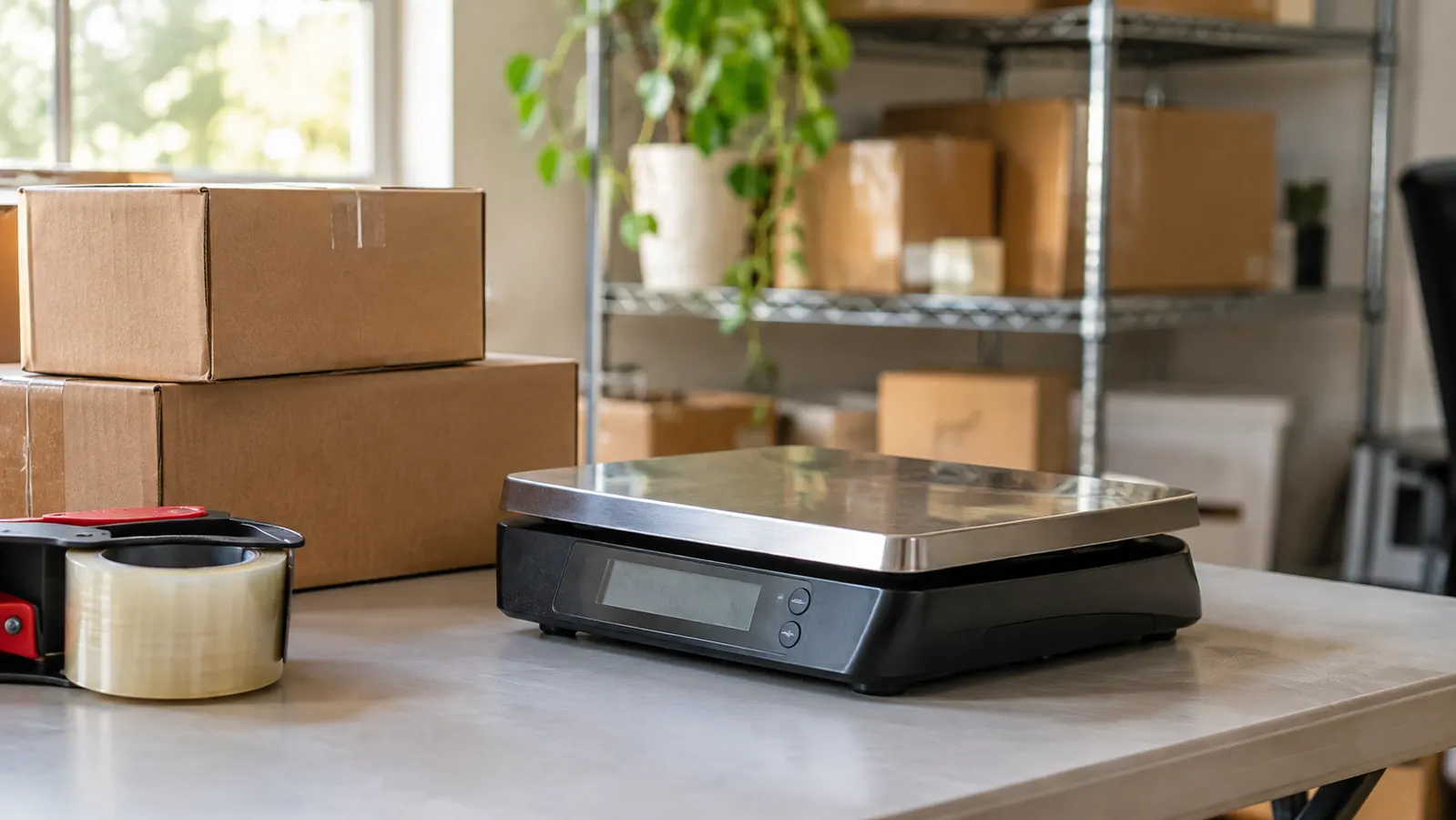
Short answer first. If most of what you ship is clothing, books and small housewares, the ACCUTECK 8250 is the scale I would buy again without thinking about it. If you routinely wrestle boxes heavy enough to make you set them down twice on the way to the door, a wide platform Smart Weigh is the better tool, and I am not going to pretend otherwise. I have packed on both. One lives on my folding table in the spare bedroom. The other sits on a shelf under it, plugged in, waiting for the weeks when I list heavy goods.
These two get compared constantly because they land in the same shopping search and both promise tenth-of-an-ounce accuracy. But they are built for different packers. One is a compact counter scale for someone shipping a dozen small parcels a day. The other is a broad flat platform for someone shipping fewer, heavier boxes. The right question is not which one wins. It is which kind of morning you have.
| ACCUTECK 8250 | Smart Weigh | |
|---|---|---|
| Capacity | 50 pounds maximum | Rated well past that on the wide platform models, beyond what I can lift comfortably |
| Fine resolution | Reads to 0.1 oz and holds steady under a pound | Gets coarser on the high capacity models |
| Display | Large backlit LCD, readable from a standing position in a dim room | Plain LCD, fine in daylight, a squint before sunrise |
| Power | Included AC adapter or AAA batteries | Batteries only on the models I have handled |
| Platform size | Sized for poly mailers and shoe boxes | Wide enough for a big carton to sit flat, all four corners down |
| Tare and hold | Both, and they work reliably | Both on most models |
| Storage | Folds flat and slides under the wire shelf | Stays on the table, because it has nowhere else to go |
| Upfront cost | Costs more up front | Costs less up front |
| Best for | Daily small parcels in a tight space | Occasional heavy boxes and box lots |
How I Ended Up With Two Scales
I bought the ACCUTECK 8250 about four years ago, after a kitchen scale died in the middle of a listing session and I mailed three packages on guessed weights. Two of them came back postage due. If you have never had a buyer send you a photo of a yellow slip taped to their door, I can tell you it is a small humiliation that costs you twenty minutes and a refund you had not planned on. I ordered a real postal scale that night and I have not guessed a weight since.
The boots were the expensive one. I had guessed two pounds and they came in at three pounds four ounces, which on a priority mail label is enough of a gap to matter. When the ACCUTECK arrived I reweighed everything already listed on the shelf out of spite and found four more listings that were light by an ounce or two. Correcting them took an evening I had not budgeted. Leaving them would have cost me a ding on my seller account, and I had worked too long to hand that over to a dead kitchen scale.
That scale has lived on the folding table ever since. It has weighed dresses, cast iron skillets, three full seasons of a paperback series, and one badly packed ceramic lamp I will not discuss. Then last spring a neighbor who sells tools asked me to help her price out a box lot of drill sets. She brought her Smart Weigh over because her cartons were heavier than my fifty pound limit, and that was the first time I used one for more than five minutes at a stretch.
I bought a wide platform Smart Weigh of my own a year ago for the weeks when I list heavy goods. So both sit in the same room now, and this comparison is based on a few hundred mornings of packing on each rather than on a spec sheet I read once. That is the only kind of opinion I trust on a tool like this.
Where ACCUTECK Wins
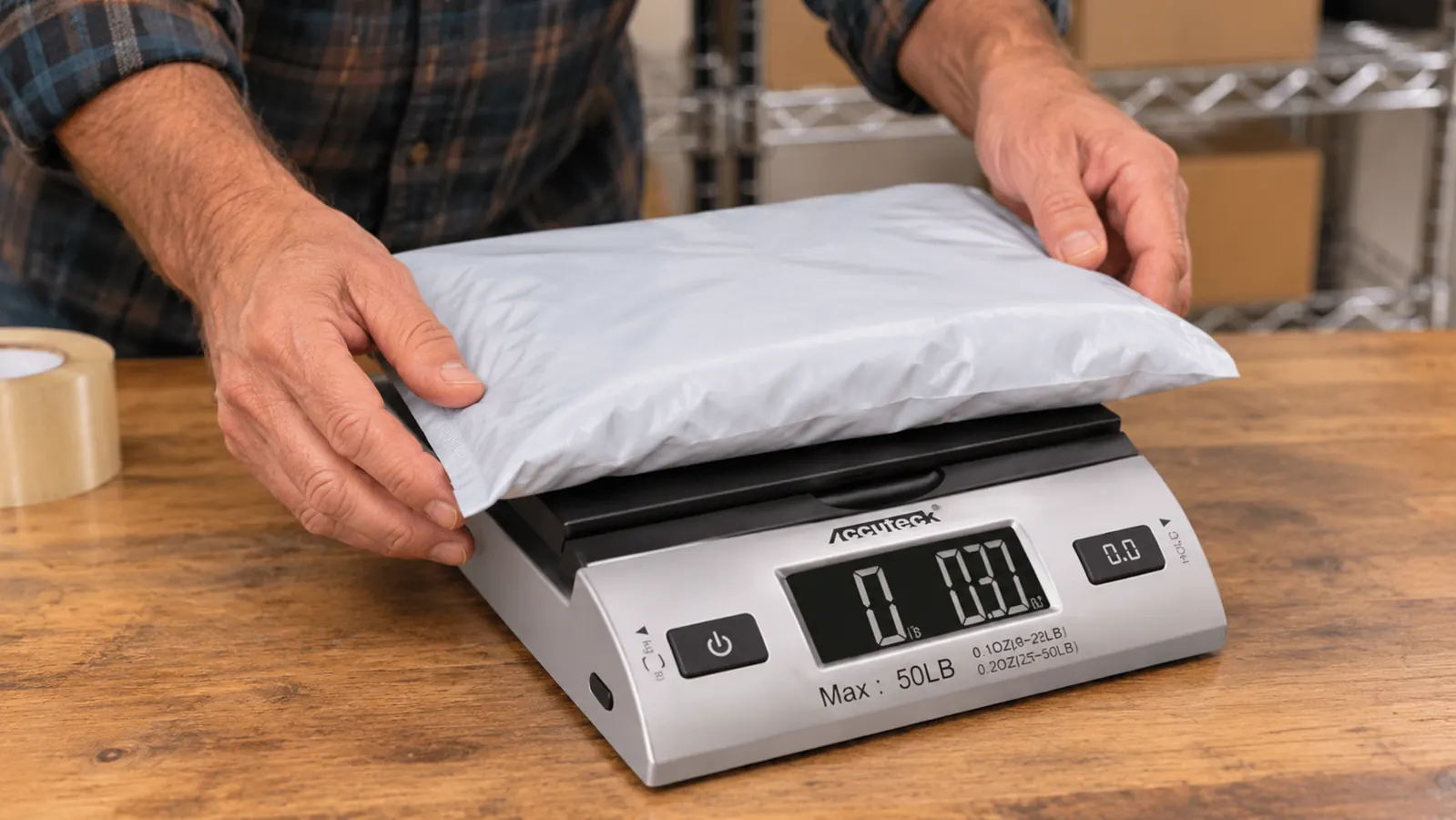
Accuracy on small parcels is the whole reason it stays on the table. The ACCUTECK reads to 0.1 oz and the number settles and stays settled. When I ship a single blouse in a poly mailer, the difference between 5.2 ounces and 5.6 ounces changes my first class postage, and I want the reading to stop moving while I am still deciding whether to add a piece of tissue. My Smart Weigh is honest at that weight, but it hunts more, drifting a tenth or two before it makes up its mind.
The display is the second thing. My packing room is a spare bedroom with one lamp and a window that faces a hedge, and in January it is dim in there until nearly eight. The backlit LCD is readable from a standing position, which matters when both your hands are full of a box. The Smart Weigh screen is fine in good light and a squint in bad light. I keep a small clip lamp clamped to the shelf for exactly that reason, and even with it on I still have to lean down to read the Smart Weigh, which is one more lean in a morning that is already made of leans.
Then there is where it goes when I am done. It folds flat and slides under the wire shelf, which in a room this size is not a small feature. The Smart Weigh stays on the table because there is nowhere else for a platform that size to live, and I have knocked a mug onto it twice now.
Where Smart Weigh Wins
Capacity, plainly. The wide platform Smart Weigh models are rated far past my ACCUTECK's fifty pound ceiling, and when you are weighing a carton of hardbacks or a set of barbell plates, that ceiling stops being theoretical and starts being the reason you cannot finish a listing. Fifty pounds is a real limit. I have hit it, and I have stacked two lighter boxes to work around it, which is exactly the sort of improvising a scale is supposed to eliminate.
Platform size goes with it. A big carton on a compact scale overhangs the edges, and an overhanging box reads light or reads wrong depending on where the load sits. When Gary carries a heavy box down for me, I want all four corners flat on the platform with nothing balanced. The Smart Weigh does that. The ACCUTECK is sized for mailers and shoe boxes and it is honest about it.
It also costs less up front, which for someone still deciding whether reselling is worth their weekends is not a small consideration. There is no reason to spend more on a first scale than you have to.
If your morning is twelve poly mailers instead of one heavy carton, this is the scale to start with
The ACCUTECK 8250 weighs to 0.1 oz up to 50 pounds, has tare and hold functions, a backlit LCD, and runs on the included AC adapter or AAA batteries. It folds flat when you are done with it.
Amazon Check Today's Price on Amazon →The Test That Actually Matters
A shipping scale is not judged on a spec sheet. It is judged at 6:40 in the morning, coffee going cold, six orders laid out, post office run at eight. Under that pressure the questions get narrow. Does it turn on and settle before I stop looking at it. Does it hold a reading while I lean over for tape. Does it come back after auto shut off without me saying something I would not repeat in front of my husband.
Take a Tuesday last month. Seven orders on the table, one of them a wool coat going to Michigan and one a pair of boots going to Oregon. I set the empty box on the platform, pressed tare, dropped the coat in, read two pounds six ounces, taped the seam, printed the label, and was out the door by ten past eight with time to stop for coffee on the way. That whole sequence took under four minutes because nothing on the scale argued with me. Tare is the function people underuse. I use it on every single order because I pack directly into the shipping box, not into a tray. Hold locks a reading on a parcel too big for you to see around. Both of these work on the ACCUTECK and on the Smart Weigh, and I would not buy a scale without them.
A scale that argues with the post office by two ounces costs you a reprint, a refund and a second trip to the counter. That is the only accuracy test that has ever mattered to me.

Four Years on the Same Table
The ACCUTECK has been in service four years and I have replaced the AAA batteries twice. Mostly I run it off the included AC adapter now, because a scale that dies mid-session is what started this whole thing. Auto shut off saves the batteries but it will also switch off while you are busy taping, so you learn to tap the platform before you set a parcel down. That is a habit, not a defect.
I did drop a tape gun on it in year two and put a small scuff on the corner of the housing. It still reads the same. That is the entire damage report for four years of daily use. Once a month I check it against a five pound bag of sugar, which is close enough for what I do, and it reads the same every time. The Smart Weigh has been here about a year. The only wear I see on it is on the platform surface where boxes slide, which is cosmetic.
What Neither Scale Fixes
Neither one will stop you from putting a label on the wrong box because you weighed one parcel and labeled another. I have done that exactly once, in December, and the buyer was kind about it in a way I did not deserve. Neither one will save a carton that is already soft on one corner. Neither one will tape a seam for you. What they do is remove one guess from a job that has plenty of others left, and I think that is worth being clear about before you spend anything.
The other thing I would tell you is that the scale is not where the money goes. Boxes, tape, bubble wrap, label paper and the gas to the drop off all add up faster than the scale does. Buy the one that fits the parcels you actually ship and put the rest into packing material. A well packed twelve ounce package arrives intact. A badly packed heavy one gets a claim filed on it, and you will lose that claim.
Who Should Buy Which
Buy the ACCUTECK 8250 if your week looks like mine. Clothing, books, small housewares and media, packed and shipped in the morning, in a room where table space is already spoken for. Fifty pounds covers the overwhelming majority of what a part time reseller moves, the 0.1 oz resolution is right for first class and media mail, and the backlight and the flat fold matter more in daily use than they sound like they would. The 4.8 star average across more than 68,000 reviews is not proof you will love it, but it is fair evidence that it does not fall apart in year two.
Buy a wide platform Smart Weigh if you deal in heavier goods. Tools, cast iron, gym equipment, box lots of books, anything where a carton makes you plan your route to the car. The wider platform and the higher ceiling are the reason, and they are good reasons. Just know you are giving up the backlight, giving up the plug in option on most models, and giving up the table space it will permanently occupy.
If you are somewhere in the middle, and most people are, start with the ACCUTECK and add the wide scale later if you keep bumping into the capacity. That is the order I did it in and I would do it the same way again. The compact scale earns its spot every single day. The big one earns its spot three or four times a month, which is enough to keep it, but not enough that I would have started there.
The one that fits under the shelf and reads to a tenth of an ounce
Tare, hold, auto shut off, backlit LCD, kg and lb/oz and oz, and an AC adapter in the box so it does not quit on you halfway through a stack of orders. The compact choice for a part time reseller shipping small parcels every morning.
Amazon See Today's Price on Amazon →