

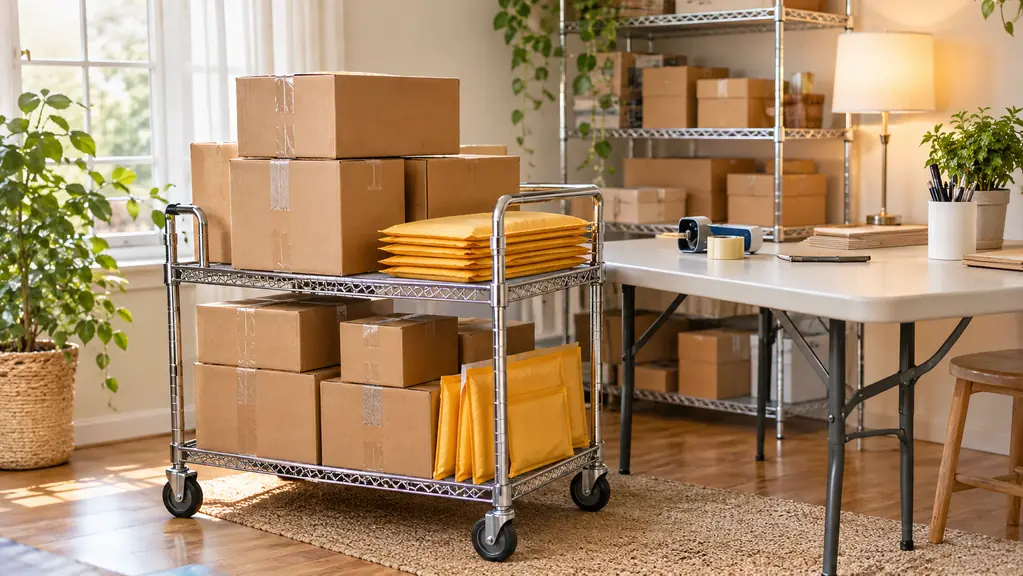
The first package I ever shipped went out with postage I guessed at. I stood in my kitchen holding a folded cardigan and told myself it felt like a pound. It was closer to two. Three days later the buyer sent me a photo of a slip that said postage due, and I spent an afternoon apologizing to a stranger over a sweater. That was six years ago. I work out of the spare bedroom now, with a folding table, wire shelving for inventory and a rolling cart for the boxes going out. Every package gets weighed. The ACCUTECK 8250 sits between the tape gun and the label printer, and it is the least interesting tool I own.
None of this is complicated. A postal scale is a small flat platform with a display, and its job is to tell you what a box weighs before you buy a label for it. The ACCUTECK does that to 0.1 ounce accuracy up to 50 pounds, which covers everything from a single paperback to a box of cast iron skillets. What follows are the ten reasons it earns its spot on that table, roughly in the order I came to care about them.
Weigh the box before you buy the label
The ACCUTECK 8250 holds 50 pounds, reads to 0.1 ounces, and runs on the included AC adapter or on AAA batteries. It is the one tool in my packing room I touch every single morning.
Amazon Check Today's Price on Amazon →It ends the postage due apology message
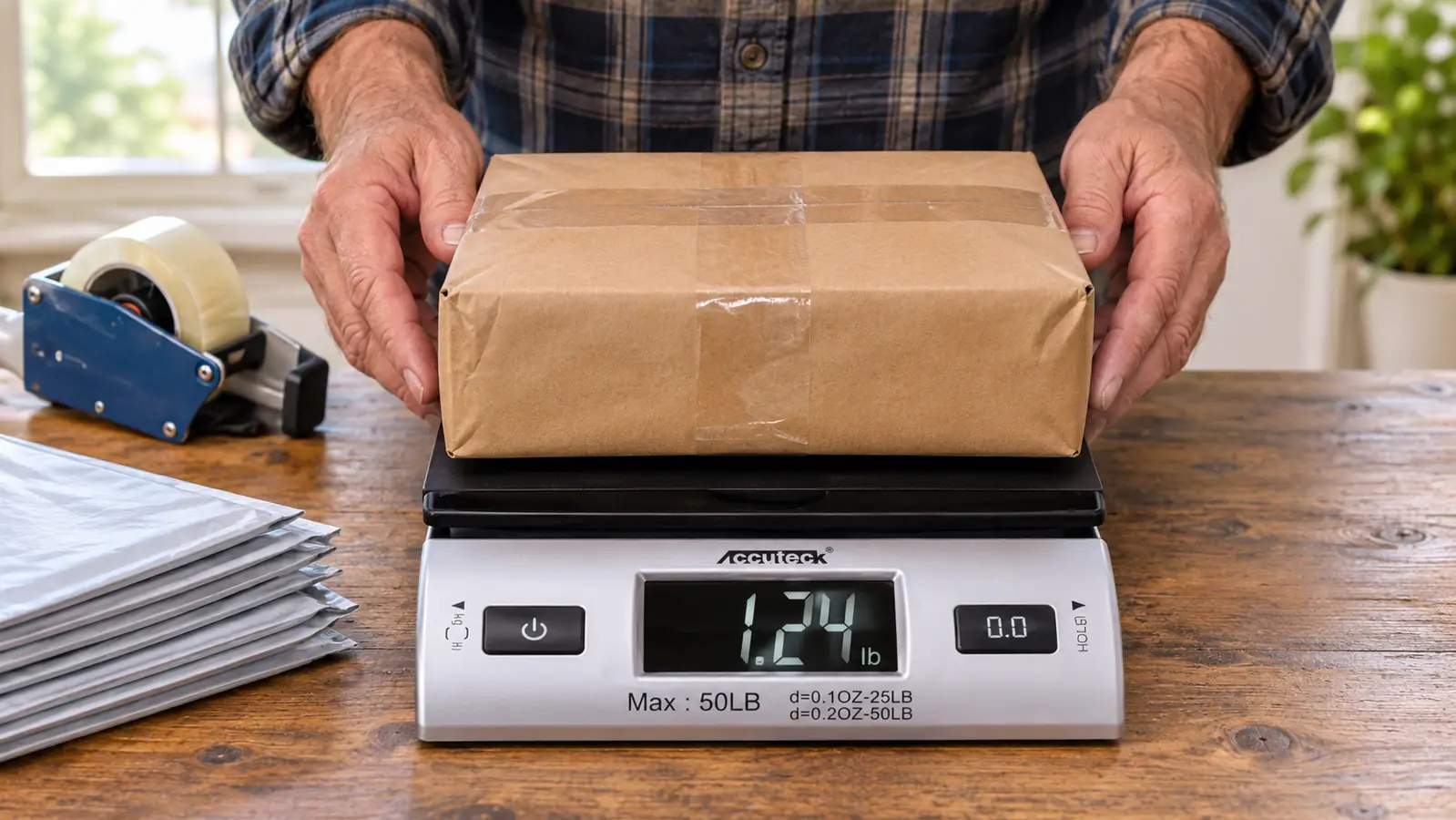
A label that is short by an ounce does not get caught at your table. It gets caught at the buyer's door, or it comes back to you with a note attached. Either way you are writing an apology to someone who already paid you, and you are doing it over a mug or a paperback that cost you more to ship than you thought. I weigh every box before the label prints now. I have not sent one of those notes in years. The scale did not make me smarter about postage. It simply removed the guess.
It stops you rounding up out of nerves
When you do not know a weight, you guess high. Guessing high feels safe, and it quietly costs you on every order you pack. Guessing low gets the package bounced back. Weighing gets you the actual number, which means you buy the label the box needs instead of the label your nerves want. Over a week of mornings that difference shows up as fewer labels in the trash and fewer surprised messages in your inbox. I noticed it inside the first month, and it was not close.
It takes a 50 pound box without complaint
Most of what I sell is clothing and small housewares, but book lots and cast iron get heavy faster than you expect. A box of five hardbacks is not a light object. This one is rated to 50 pounds, so I am not weighing a book lot in two trips or hunting for a different machine when a heavy order comes through. Gary carries those out to the drop off for me. The scale deals with them at the table, flat and steady, and the platform does not flex under the weight.
The tare function does the box math for you
Set the empty box on the platform, press tare, and the display returns to zero. Load the item and the number you see is the item alone, not the item plus the carton. That sounds like a small convenience until you have done the subtraction wrong on a three piece order and printed a label for the wrong weight. Tare means I never jot numbers on the back of my hand and never guess whether I already counted the box. Three seconds, every package.
Hold locks the reading when the box covers the display
A large box hides the screen. You cannot read a number you cannot see, and you cannot hold a full box steady with one hand while you lean around it. Press hold and the reading freezes, so you can shift the package or step back and read it properly. I use it constantly on book lots and on anything packed in a big flat box, where the package is wider than the platform and the display disappears behind brown cardboard the moment you set it down.
The backlit display is readable at six in the morning
I pack most mornings before the daylight gets into that room. The lamp on the folding table is not much, and the LCD on this scale is backlit, so the numbers come up clear without me squinting or dragging the whole setup toward a window. It is a small thing, and it is the kind of small thing you notice every single day once you have had a scale where you could not read the last digit. Coffee in one hand, box in the other, number still visible.
It runs on batteries or the wall adapter, whichever is closer
The scale comes with an AC adapter and also takes AAA batteries, so it does not have to live next to an outlet. Mine stays plugged in at the table most of the time. When I pull the rolling cart out to sort a thrift haul in the living room, the batteries carry it and I can weigh as I sort instead of stacking everything back into the bedroom first. A tool that only works in one spot ends up being a tool you walk past.
Three units, so you stop converting in your head
It reads in ounces, in pounds and ounces, or in kilograms. Ounces for small items, pounds and ounces for the carrier forms, kilograms when a buyer asks a question in metric. I spent a year doing that arithmetic badly in my head, second guessing myself on every listing. Now I press a button until the display matches the form in front of me. It sounds trivial written down. It is not trivial at seven in the morning when you have nine packages to get through.
It folds flat and lives on the wire shelf
The platform folds up and the whole unit weighs about 2 pounds, so it tucks onto the wire shelf between the padded mailers and the spare tape when the folding table needs to be clear. My packing room is a spare bedroom, not a warehouse, and anything that cannot be put away does not get to stay. This one takes up the footprint of a hardback book when it is folded. I have never once had to move something else to make room for it.
It gives you a number when a buyer questions one
Every so often a buyer says the package weighed less than the label claimed, or a return turns up with a shipping charge attached to it. Knowing what the box actually read turns that from an argument into a fact. I keep a photo of the reading on heavy orders. The scale also shuts itself off after a stretch of no use, which means I have stopped killing a set of batteries by leaving it on overnight after a late packing session.
The scale did not make me smarter about postage. It removed the guess, one box at a time.
What I'd Skip
A kitchen scale is built for flour, not for a box of books. The platform is small, the capacity is usually well under what a book lot needs, and there is no hold function, so a wide package hides the reading the second you set it down. I tried it for a month before I gave in. It is not the same tool, and treating it like one is how you end up back at the post office counter with a package in your arms.
I would also skip the big platform scales built for warehouse counters, and anything so cheap that you cannot get a replacement adapter for it two years later. What you want is a plain counter scale: readable in a dim room, good to 50 pounds, powered from the wall or from batteries, with tare and hold. That is the ACCUTECK, and it is the only piece of shipping equipment I have bought once instead of three times.
One number before the label prints
Six years of eBay and Poshmark packages taught me the same lesson in a different way each time. Weigh the box. The ACCUTECK 8250 sits on a folding table in a spare bedroom in Dayton and does exactly that, every morning, without ever being interesting about it.
Amazon Check Today's Price on Amazon →