
The first thing I did after I bought the ACCUTECK 8250 was weigh a pair of jeans that had already been packed, labeled and dropped off. They came in at 1 pound 9 ounces. I had bought a 2 pound label for them, which means I had been paying for postage I did not need on almost every clothing order for two years. That is the part nobody mentions about a postal scale. It does not only stop you from underpaying. Most of the time it stops you from overpaying, quietly, on order after order, until the total is a number you would rather not add up.
I am not a big operation. I pack in the spare bedroom of my house in Dayton, Ohio, and I sell thrifted clothing, housewares and the occasional book on eBay and Poshmark, with a little Mercari on the side. I have been at it about six years, part time, fitted around everything else. My week runs on a routine: source on weekends, list in the evenings, pack and ship most mornings. For a setup like that, a scale is not a gadget on a wish list. It is the piece of equipment that decides whether a morning goes smoothly or turns into a second trip to the post office.
The Quick Verdict
A plain, sturdy 50 pound counter scale that ended my guessing on postage. The tare and hold functions do the real work here, and after a year of daily use nothing on it has failed. It will not measure a box for you, so keep a tape measure next to it.
Amazon Check Today's Price →The 2 pound label on a 1 pound 9 ounce package is money you never get back
The ACCUTECK 8250 reads to a tenth of an ounce, handles boxes up to 50 pounds, and runs on the included AC adapter or AAA batteries. Check today's price and stop guessing at the counter.
Amazon Check Today's Price on Amazon →How I've Used It
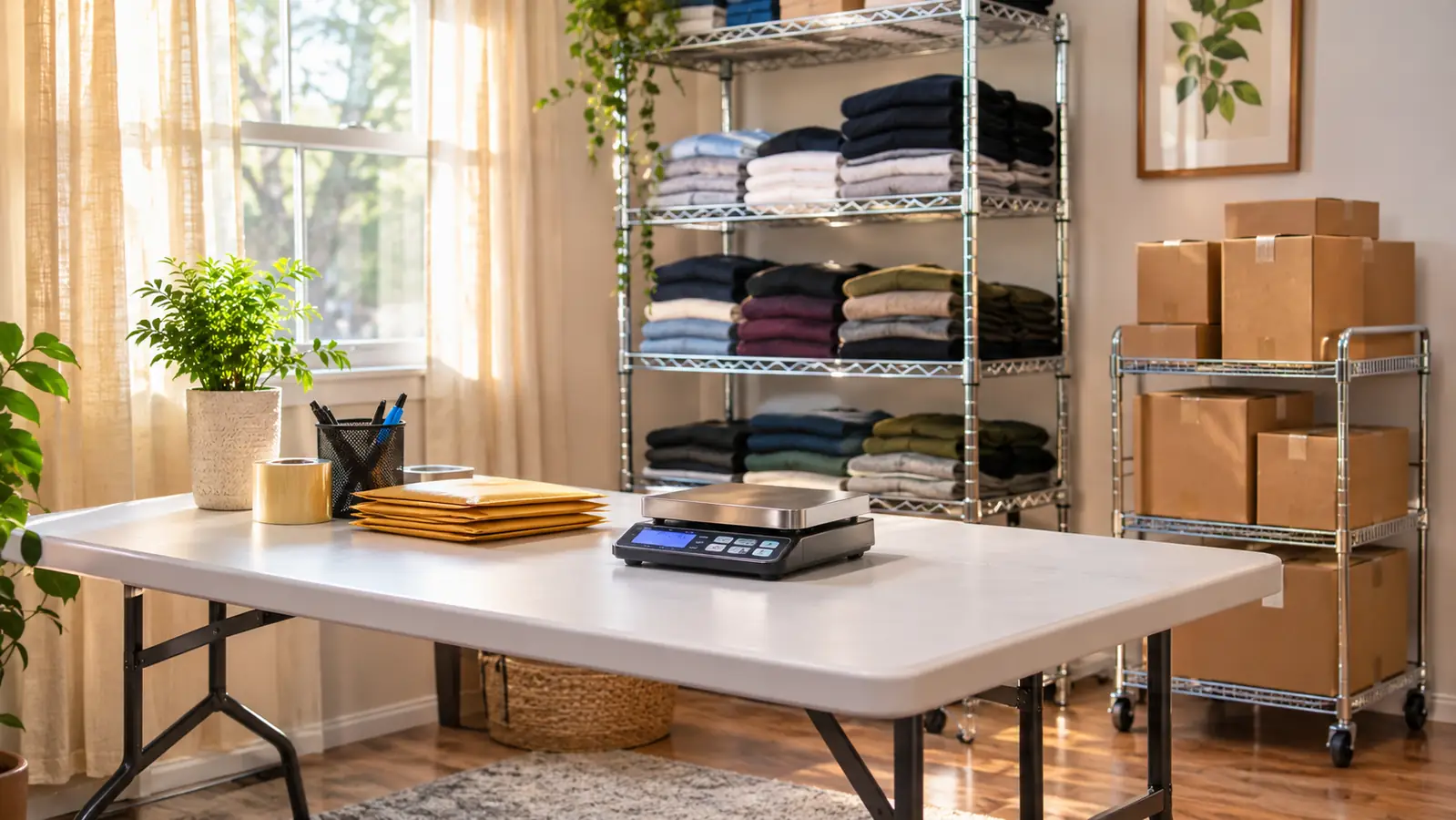
The scale sits on my folding table next to the tape gun and a stack of poly mailers, and in a year it has not moved. Setup took about a minute. It ships with a battery and an AC adapter, and I plugged the adapter in and have not thought about power since. The auto shut off darkens the display when I walk away, and it comes back on when I set a package down. My mornings start with the rolling cart of packages I packed the night before, and each one gets weighed before I print anything.
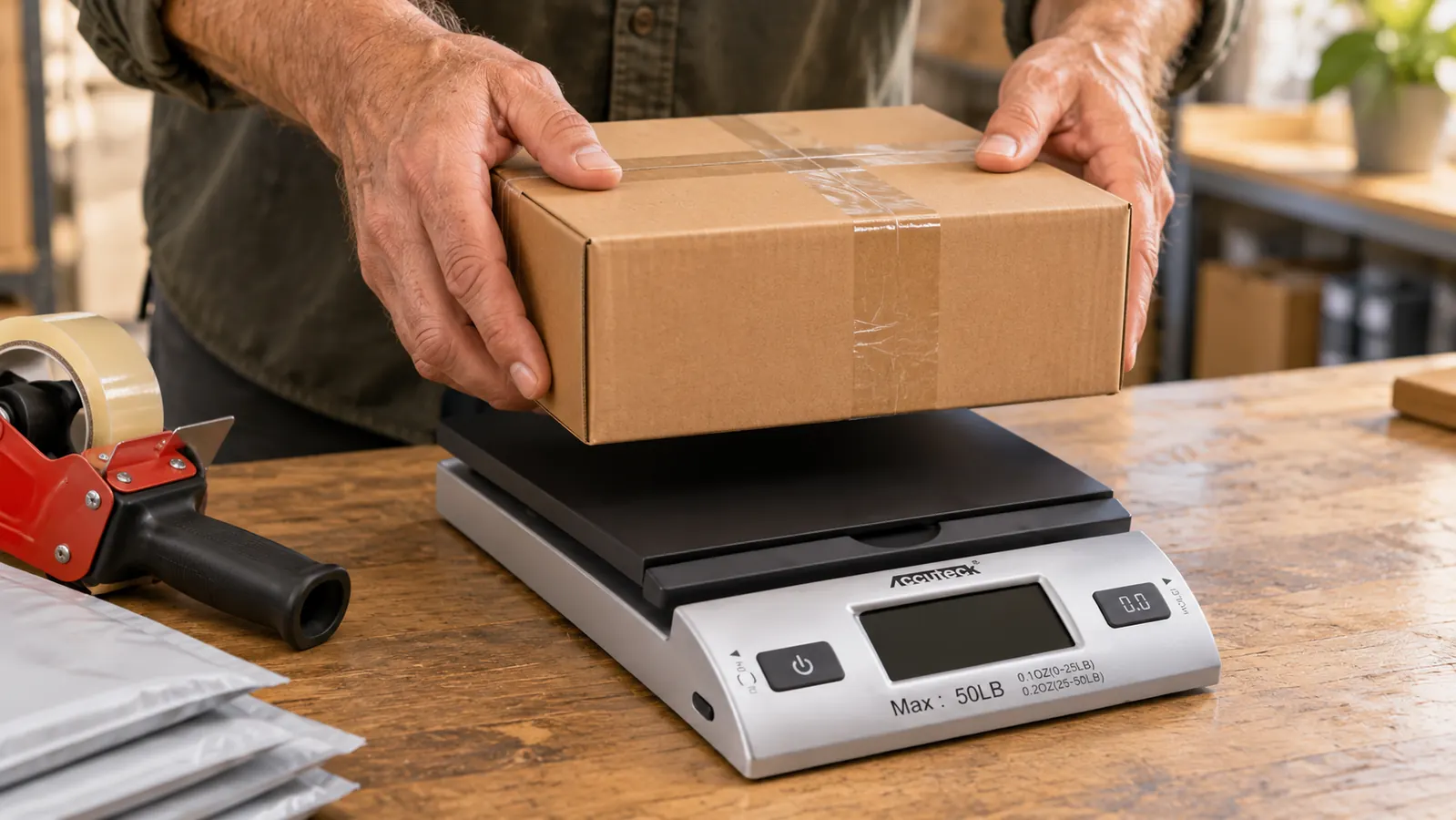
The sequence is the same every time. The mailer or box goes on the platform, the weight reads, I press the tare button, and the display drops to zero. Then I load the item and the packing material, and the number on the screen is shipping weight and nothing else. When I am working with a box tall enough that it hides the display, I use the hold function to lock the reading, set the box down, and read it at eye level. That is the whole workflow. It costs me a few seconds per package, and after a year I do it without looking.
The first week I owned it, I weighed everything twice. Ten packages in a row, write the number down, weigh again, compare. All ten matched. That sounds like a low bar for a piece of equipment, but my old kitchen scale had a habit of drifting by half an ounce depending on where the box sat on the platform, and half an ounce is the difference between one postage tier and the next on a light item. Once I trusted the number, the morning got faster. I stopped double checking, I stopped padding every label with an extra ounce of cushion, and I stopped standing at the counter wondering whether the clerk was going to weigh my package again and frown at it. That was worth more to me than anything printed on the box.
A normal week is forty to sixty packages, so call it two and a half thousand over a year. Gary, my husband, carries the heavy boxes out to the car for the post office run. The scale changed his job too, because he no longer guesses which tote is going to tweak his back. He reads the number, picks up what he can carry, and leaves the rest for the cart.
The Tare Function Is the Reason I Bought It
For two years before this I used a kitchen scale. It worked fine for a single paperback and it was useless for anything else. A box hangs off the platform, the display ends up underneath, and I would balance the thing on one corner and hope. Then I would write the weight on a sticky note, weigh the empty box, and subtract on a calculator. Every package took three steps that had nothing to do with shipping.
The tare button on the 8250 collapses that into one press. Box on, tare, load, read. The scale does the subtraction, which means I do not, which means I do not get it wrong at 6:40 in the morning before I have finished my coffee. Over two and a half thousand packages that is a lot of arithmetic I did not do, and a lot of small errors that never happened.
Small items are where tare earns its keep. A padded envelope weighs something, and on a pair of earrings going out through Mercari, that envelope is a bigger share of the total than the earrings are. Before, I would weigh the earrings, weigh the envelope, add the two in my head, and then round up because I did not trust the arithmetic. Now the envelope goes on first, I press tare, the earrings go in, and the number on the screen is the number I type into the label form. The first time I did it I did not believe the reading was that low, so I took the package off, reset the scale, and did the whole thing over. Same number to the tenth of an ounce.
One thing to know: tare is per box. When you set a new mailer on the platform, you press tare again, or bring it back to zero first. It is not automatic, and if you forget, the container weight rides along in your reading. I forgot twice in the first month and both times I caught it before printing a label.
What a Year of Daily Weighing Taught Me About Accuracy
The readout on the ACCUTECK goes to a tenth of an ounce, and it does not wander. I have weighed the same sweater three times in a row out of curiosity and gotten the same number each time. That consistency matters more than people realize. A scale that reads 1 pound 4 ounces, then 1 pound 6 ounces, then 1 pound 5 ounces is a scale you cannot trust to pick a label, so you buy the heavier one to be safe, and you are right back where you started.
About three months in I carried three packages to the counter and asked the clerk to weigh them after I had already printed the labels. All three matched what the ACCUTECK had told me that morning. It is a small test and I know it, but it answered the question I actually had, which was whether the number on my folding table meant anything at the counter. The listing gives readout accuracy at 2.86 grams, a finer increment than a sweater will ever need. What I needed was the same answer twice in a row, and it gave me that from the first week and has not stopped.
It reads in kilograms, in pounds and ounces, and in plain ounces. I keep mine on pounds and ounces for clothing and switch to plain ounces for small things, a single paperback or a pair of earrings in a padded envelope. The switch is a button press. The display is large and backlit, which matters in my situation, because the table sits in the corner of the room where the lamp is not great and I do most of this before the sun is properly up.
Two and a half thousand packages in, the scale still gives me the same number twice in a row, and I have not had a postage adjustment since the week I bought it.
The 50 Pound Platform and What It Fits
The ACCUTECK 8250 is rated to 50 pounds, which is far more than I need for a sweater and roughly right for the heaviest thing I sell, which is a box of hardcover books. I have loaded that platform with a full box of books and it read without complaint. No error code, no blinking, no drift. The form factor folds, so it stores flat on the shelf when I clear the table to photograph inventory, and it comes back up in a second.
The book box is the test I keep coming back to. A flat rate box packed with hardcovers is the densest thing I ship, and the first one I weighed came in just over 30 pounds. The platform did not flex, the reading did not flicker, and the number held steady while I wrote it down the side of the box in marker. I have shipped heavier since, a set of stoneware bowls that came in near 40, and the scale treated it exactly the same way. What I notice now is that fold. When I clear the table to photograph inventory, it folds down and goes on the shelf beside the tape gun, then comes back up in a second when I need it. A scale that lives permanently on the table is a scale that eats the space I need for a light box and a backdrop.
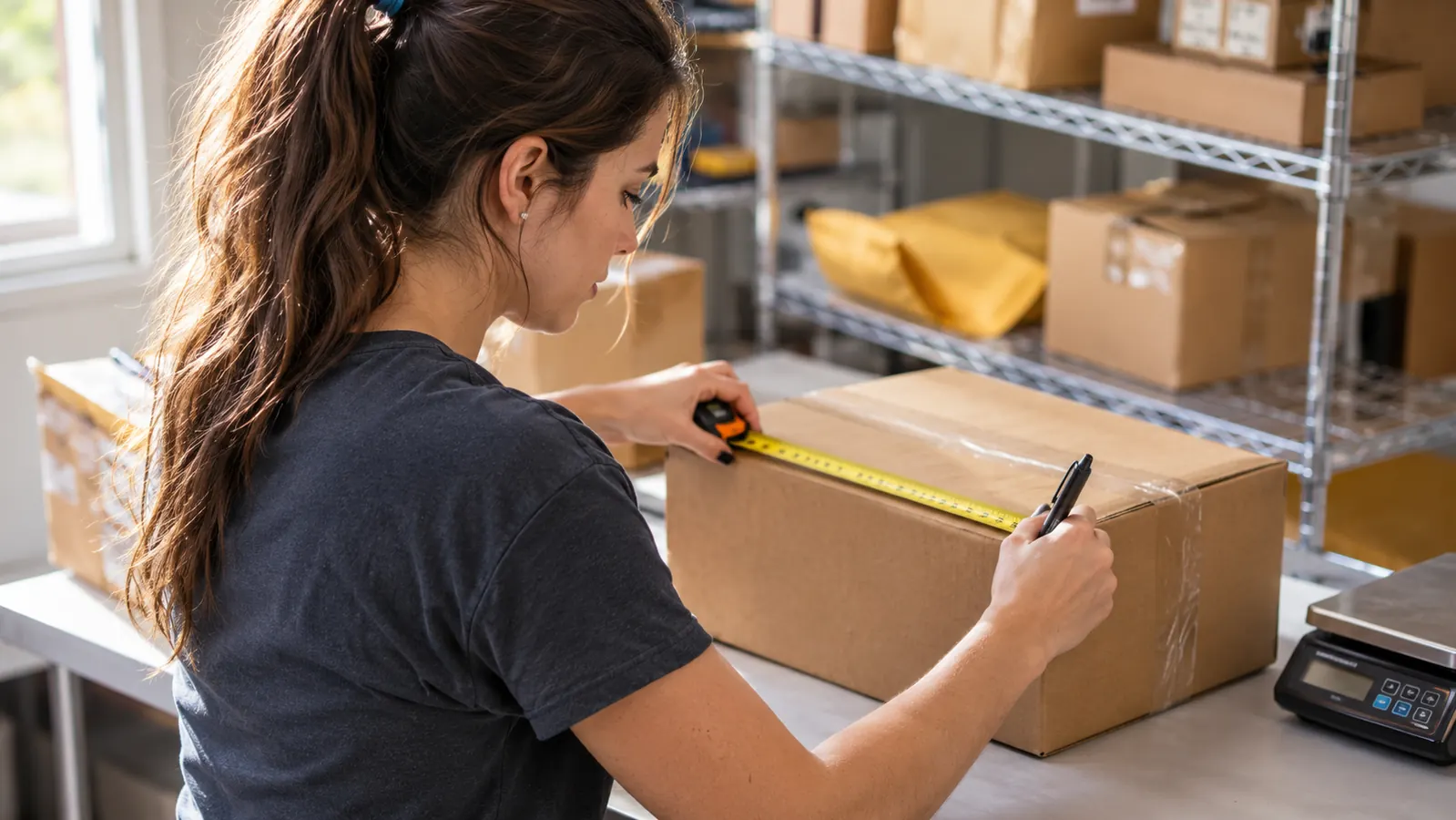
What it will not do is measure a box for you. It is a counter scale, and a large moving box will overhang the platform. Overhang does not break anything, but it can hide the display, which is exactly when the hold function earns its place. The other thing a scale cannot tell you is dimensional weight. Carriers care about size as well as weight on bigger parcels, so I keep a tape measure beside the scale and write length, width and height on the box in marker before I buy the label.
The Small Annoyances
The auto shut off is a good feature that occasionally gets in the way. If I stop mid-pack to take a call or hunt down a piece of bubble wrap, the scale goes dark, and when I set the package back down it reads the full weight again instead of the tared weight. I press tare and move on. It adds a second, not a problem, but it is the kind of thing you notice in the first week and then stop noticing.
The one habit I had to build is the reset. Tare is a key press, not a state, and after a morning of small envelopes I have caught myself setting a box down and reading a number that still had the last mailer subtracted from it. The number looked low, which is how I knew. It is the kind of mistake that costs one label and one trip back to the counter, and it gets rarer every month. I now press tare, look at the zero, and then load the box. Two seconds of attention, and it has saved me more than once.
The dual power is more useful than it sounds, though I have only used half of it. The adapter lives plugged in next to the table, so the AAA batteries in the back are a backup I have never needed. If I ever wanted to weigh something in the garage or at an estate sale, the batteries would let me. I have not, but the option is there and it does not cost me anything to leave it there.
What I Liked
- Tare and hold functions turn a two step guess into a one press reading
- Reads to a tenth of an ounce and repeats the same number on repeated weighs
- 50 pound capacity handles a full box of hardcover books without complaint
- Backlit LCD is readable in the dim corner where my packing table sits
- Runs on the included AC adapter or AAA batteries
- Folds flat for storage between packing sessions
Where It Falls Short
- Tare has to be pressed again for each new box
- Auto shut off drops the tared reading if you pause too long
- It weighs only, so you still need a tape measure for dimensional weight
- Large boxes overhang the platform and can hide the display
Who This Is For
If you ship more than a handful of packages a week, this is the piece of equipment I would buy before anything else, including a label printer. It suits a home reseller working off one table with a cart of outgoing orders, someone selling clothing, books, housewares or small electronics. It suits anyone who has stood at the counter and been told the postage was short. It also suits a household that ships the occasional care package, because 50 pounds of capacity covers luggage and boxes that a kitchen scale simply cannot handle.
Who Should Skip It
Skip it if you need a scale that talks to your shipping software, prints a label, or works out dimensional weight on its own. This one measures weight and nothing else. Skip it if you regularly ship parcels over 50 pounds, because you will be past the limit and the reading will tell you so in the middle of your packing morning. And skip it if you mail two or three things a month and already own a decent kitchen scale, because a kitchen scale and a sticky note will get you through.
A year of morning weighing, and the only thing I regret is the two years before it
The ACCUTECK 8250 is a 50 pound counter scale with tare, hold, a backlit LCD and dual power. It measures weight, and it does it consistently. Check today's price on Amazon before your next packing morning.
Amazon Check Today's Price on Amazon →