
I cracked a stoneware mug in the mail in my second year of reselling. The buyer sent a photo of the handle sitting loose inside a padded envelope that had gone soft somewhere between Dayton and Tacoma. I refunded her, apologized twice, and then sat at my packing table for a while feeling stupid. The mug had been wrapped. It had been padded. What it had not been was in anything thick enough or firm enough to survive a sorting machine.
That was the year I stopped treating mailers as an afterthought. I sell thrifted clothing and housewares on eBay and Poshmark, with a little Mercari on the side, and the spare bedroom has a shelf devoted to envelopes and boxes. I have been using the Fuxury 12x15 padded envelopes for about six months now, close to 400 orders, and I have formed some opinions. Most of them are good. One of them cost me a plate.
The Quick Verdict
Dense bubbles, a seal that actually holds, and a size that swallows a folded sweater. Not rigid enough to protect true ceramics on its own, and the last inch of the flap needs a firm press.
Amazon Check Today's Price →The envelope that ended my cracked-mug emails
Fuxury 12x15 padded envelopes, 25 to a pack, polyethylene with a self-seal flap. Check today's price on Amazon and keep a pack on the shelf next to the scale.
Amazon Check Today's Price on Amazon →How I've Used It
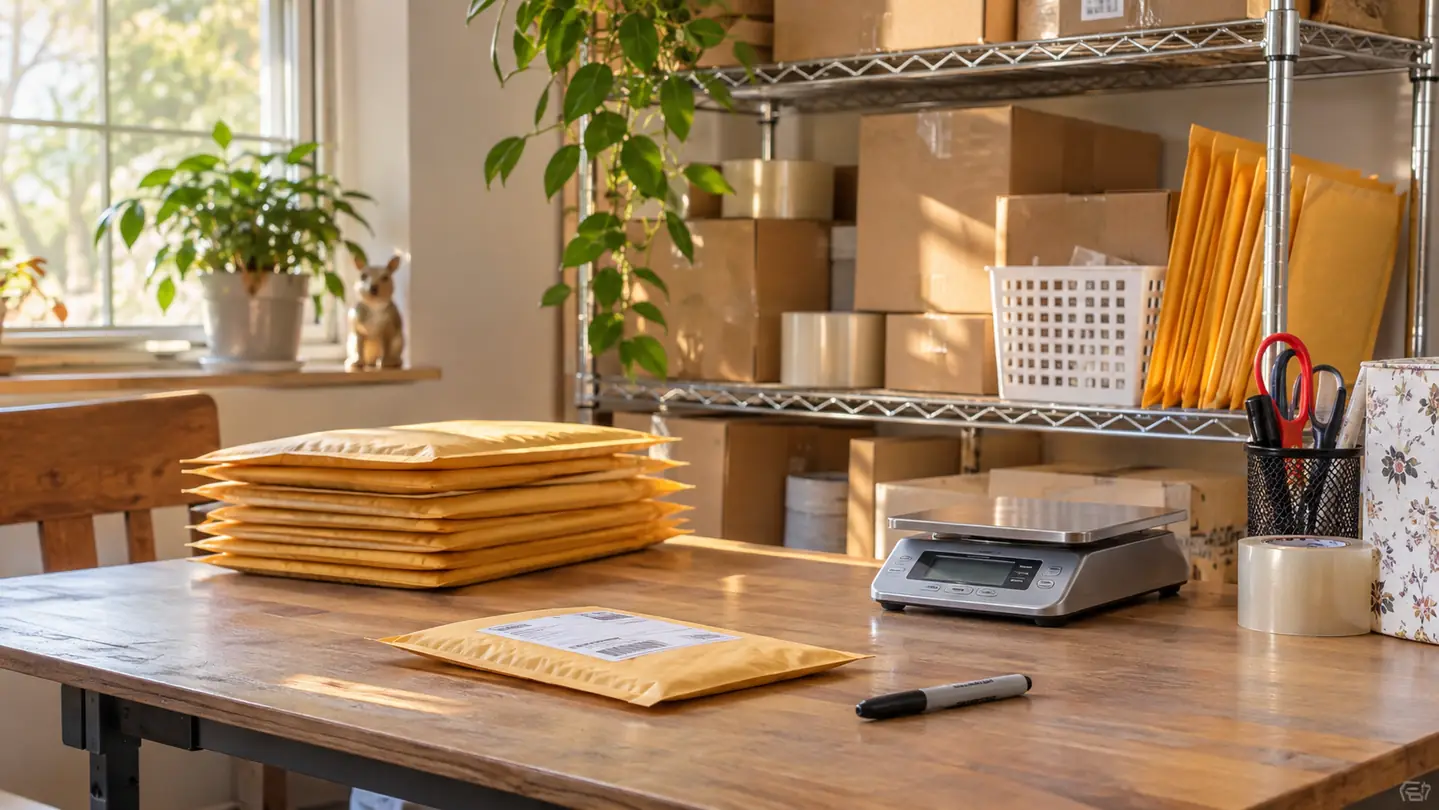
My week runs on a schedule. I source on weekends at thrift stores and estate sales, list in the evenings, and pack most mornings before Gary leaves for work. The folding table gets a stack of mailers, a tape gun, a scale, and a marker. On a normal morning I ship between eight and fifteen packages, and maybe half of them go out in a padded envelope instead of a box.
The Fuxury pack holds 25 envelopes, which lasts me roughly three weeks if I am not doing a run of clothing. I keep them flat on the wire shelving under the table so the corners do not curl. They are polyethylene with a padded layer inside, rectangular, and they close with a self-seal strip, so there is no tape involved in sealing one. That last part matters more than I expected. When you are packing twelve packages before nine in the morning, not hunting for the tape gun is a real thing.
I have reordered twice. In six months I have put folded clothing, paperbacks, small framed prints, ceramic trinket dishes that were already inside their own small box, and a set of cloth napkins through these. I have not put a bare mug in one since that first year, and I would not.
What the 12x15 Size Actually Fits
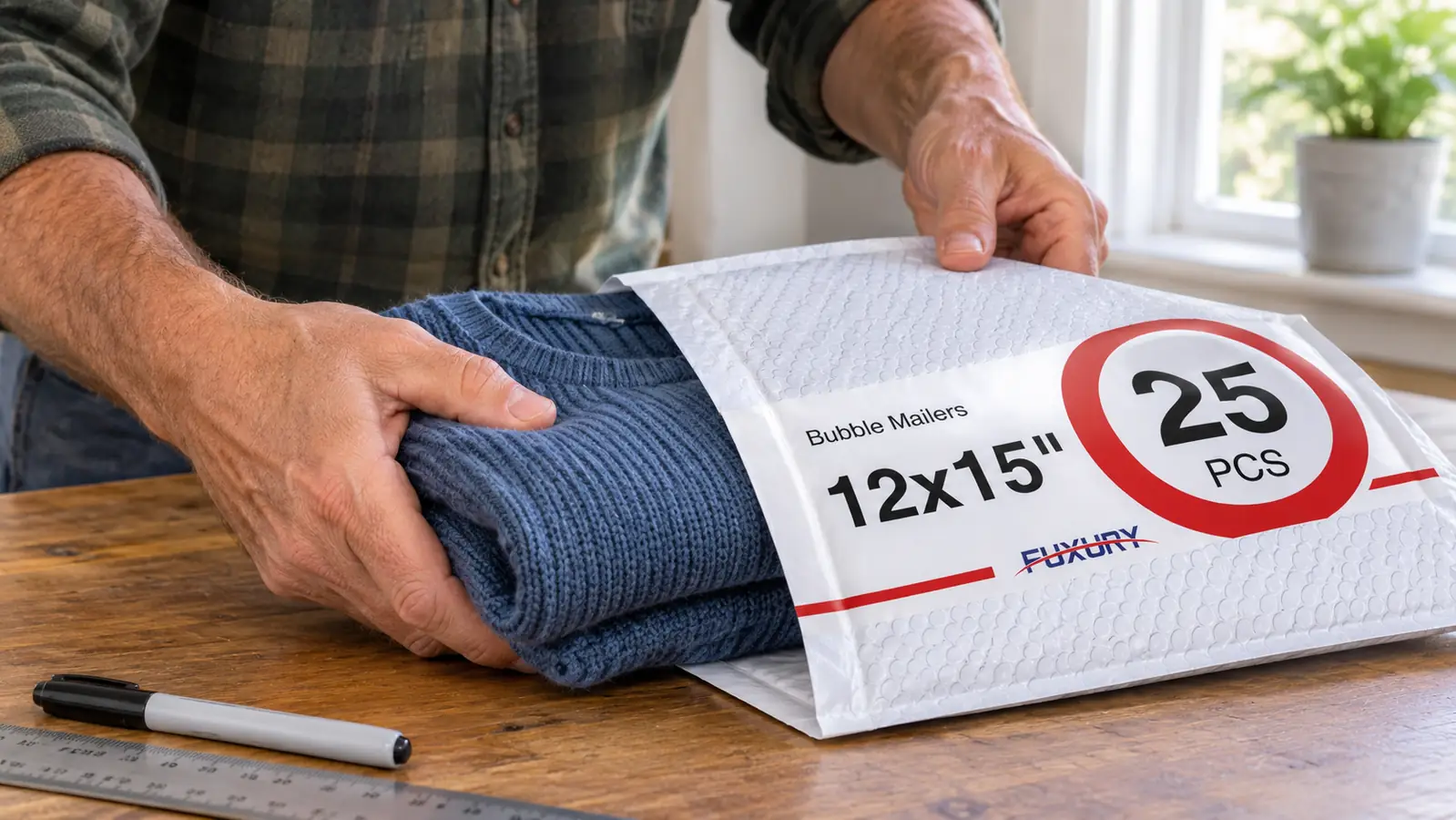
The listing calls these 12x15, and it describes the outer measurement as 12 by 16 inches with a usable interior of 12 by 15. That distinction sounds like fussiness until you are standing there holding a sweater and deciding. The usable number is the one that matters. An envelope labeled 12x15 gives you 12x15 of padded space, not a 12x15 exterior with a seam eating into the room inside.
A folded cotton sweater fits with room to spare. A pair of jeans rolled tight fits. Two paperbacks side by side fit and still leave the seal clear. A dinner plate does not fit, not without turning it on an angle and leaving a corner of the rim right where the conveyor will find it. When I am unsure, I lay the item on the table, set the mailer on top, and check that there is at least an inch of padding on every side before I peel the strip.
The item that taught me to measure was a folded quilt top, a thrifted piece I listed in April. Folded three times it measured 11 by 14, which sounds like it fits. It did fit, technically, but it fit with nothing left over, and the seal strip landed right on the fabric edge. I refolded it four times, narrower each pass, until the bundle was 10 by 13 and I had a thumb's width of padding all the way around. That is the rule I use now. If the fold leaves the seal touching the goods, fold it again.
The 12 inch width is the real constraint. Anything round and wide, like a bowl or a platter, is a box item no matter how much bubble wrap is in the house. The 15 inch length handles most clothing and most books. If your inventory leans toward flat goods and soft goods, this size will cover about eighty percent of what you need. If it leans toward anything with a rim, buy boxes.
How the Cushioning Held Up Over Six Months
The bubbles on these are small and dense and they stay consistent across the whole sheet. I have had cheap mailers where the bubble layer is thick in the middle and thin at the edges, which is exactly backwards, because the edges are what hit things first. These are not that. I pulled a flattened one out of my own recycling bin after a week under a stack of inventory and the bubble layer still had give to it.
One order stands out. In February I shipped a small ceramic trinket dish to a buyer in Oregon. The dish was already inside its own manufacturer box, so I slid the box into the mailer, sealed it, and sent it on its way. She wrote back a few days later to say the outer box had a dent in one corner and the dish was fine. That is the whole case for a padded envelope in one sentence. The dent stopped at the padding and never reached the thing she paid for.
I ran a completely unscientific test in the first month. I packed a paperback in one of these, sealed it, and dropped it off the edge of the folding table onto the hardwood six times. Then I opened it. The book was fine. The corner of the envelope was dented and scuffed. That proves very little, but it told me what I wanted to know, which is that the padding takes the hit before the contents do.
Over six months, my failures have not been burst bubbles. They have been corners. A padded envelope dragged along a sorting belt eventually wears through at the corner, and once that happens the corner of whatever is inside is exposed. I keep hard items away from the ends now, and I run a strip of tape over the two end seams on anything I truly care about. That is not a flaw in the Fuxury envelopes so much as it is what happens to any padded envelope in a mail stream.
The Self-Seal Closure and Where It Gives Out
The self-seal strip runs the full width of the flap and the adhesive is aggressive. You get one try. If you press it down crooked, you are not lifting it back up without tearing the flap, and then you are taping a torn envelope and hoping.
The first few I sealed, I ran my thumb along the edge and called it done. Two of those arrived with a corner of the flap lifted, which is how a mailer takes on water in a rainstorm sitting on a depot dock. The two that lifted were in the same week in January and both went to the same zip code upstate. I do not think that is a coincidence. Once a corner of the flap comes up even a little, water has a way in, and a wet mailer is a soggy apology waiting to happen. Now I press the full length with the heel of my hand and then go back over both ends. That takes four seconds and I have not had a lifted flap since.
The one thing you give up with a self-seal flap is reuse. A poly mailer with a taped flap can be opened and taped again. This one cannot. Once the strip meets the envelope, that envelope is finished. I mention it because I know resellers who reuse every mailer that comes into the house, and this is not the product for that habit.
How It Compares to What I Was Using
Before this I was using a big-box brand of padded envelope, mostly because I bought whatever was on the shelf. The bubble layer on those was thinner at the edges, the seal was narrower, and I had maybe one lifted flap every fifty packages. The difference is not dramatic. It is the kind of difference that shows up as one fewer apology email a month, which is worth something to me.
Against a plain poly mailer, there is no comparison to make, because they do different jobs. A poly mailer is a wrapper. It keeps things dry and together and costs very little. A padded envelope is a wrapper with a cushion, and it costs more because of that cushion. I keep both on the shelf. The plain ones go to t-shirts and soft home goods. The Fuxury envelopes go to anything that could be dented or scuffed on the way.
I sort by hand at the table and I sort fast. A cotton shirt goes in a poly mailer, folds flat, one strip of tape. A hardback book goes in a padded envelope, because a bumped corner on a book turns into a message from a buyer and then a partial refund. Same shelf, two seconds of judgment, and the only thing I am really weighing is whether the item can take a knock.
Against a small box with paper filler, the padded envelope is faster, lighter, and takes less shelf space. The box is stronger. When I am on the fence, I ask myself one question. If this gets dropped from waist height onto concrete, what happens. If the answer is nothing much, it goes in a bubble mailer. If the answer is a crack, it goes in a box with filler, and I stop arguing with myself.
Where the Fuxury Mailers Fall Short
A padded envelope is not a box, and no amount of bubble inside one will make it rigid. I learned that the expensive way with a stoneware plate that I wrapped well, padded well, and shipped anyway. It arrived in three pieces. The padding did its job. The problem was that nothing held the plate flat while a sorting machine pressed down on it. If an item cannot bend, it needs structure, and this product does not provide structure.
The second issue is cost per unit. These run more than a plain poly mailer and less than a small box with filler, so the math only works out if the item genuinely needs the padding. A t-shirt does not. I keep a stack of plain mailers right next to these and I decide by feel at the table, not by force of habit, because habit is how you spend money you did not need to spend.
The third is storage. A 25 count pack of 12x15 envelopes takes up real shelf space, and while they arrive flat they do not stay perfectly flat once the stack gets low. I weigh mine down with a spare inventory bin. If your packing area is a corner of a closet rather than a whole room, that detail is worth knowing before you order.
What I Liked
- Bubble layer stays dense out to the edges, which is where the damage happens
- Self-seal flap holds on the first firm press, no tape gun needed
- 12 by 15 of usable interior swallows folded clothing and stacked books
- 25 to a pack, so a reorder is a shelf decision rather than a weekly one
- Polyethylene padding takes a scuff or a corner dent instead of passing it through
Where It Falls Short
- No rigidity at all, so rimmed and handled items still need a box
- One-shot seal, so the envelope cannot be reused after it is opened
- Corners wear through on long trips, and hard items need to stay away from the ends
- Costs more per envelope than a plain poly mailer, and not every order needs that
A padded envelope is not a box. It buys you one layer of forgiveness, and the Fuxury layer is thicker than what I was using before.
Who This Is For
If you sell clothing, books, or small soft goods on eBay, Poshmark, or Mercari, and you pack more than a handful of orders a week, this size earns its shelf space. It is the envelope I reach for without thinking when the item is folded, flat, or soft. The self-seal flap means one less tool on the table, and the padding means fewer messages from buyers who opened a package and found a scuff.
It is also for the reseller who is tired of the tape gun. I did not expect that to matter as much as it does. Sealing an envelope in one motion, with no dispenser, no loose end stuck to your sleeve, and no scissors, is a small thing that adds up over a hundred packages. If you pack in the morning before you are fully awake, you will notice.
Who Should Skip It
If you sell ceramics, glassware, or anything with a rim or a handle, skip these and buy boxes plus bubble wrap. A mug needs structure around it. So does a plate, a vase, and a picture frame with real glass in it. I still keep a couple of these envelopes on hand for the small boxed items inside a larger order, but they are not the outer package for anything breakable.
Skip these too if you resell one or two items a month. A 25 count pack will sit on the shelf going slightly wavy and you will have spent money on inventory of a different kind. And skip them if reusing incoming mailers is part of how you keep your supply costs down, because the self-seal flap rules that out entirely.
Buy the size, not the promise
If your inventory is folded, flat, or soft, a 12x15 padded envelope is the right call. Check today's price on Amazon, order a pack, and stop taping flaps at seven in the morning.
Amazon Check Today's Price on Amazon →