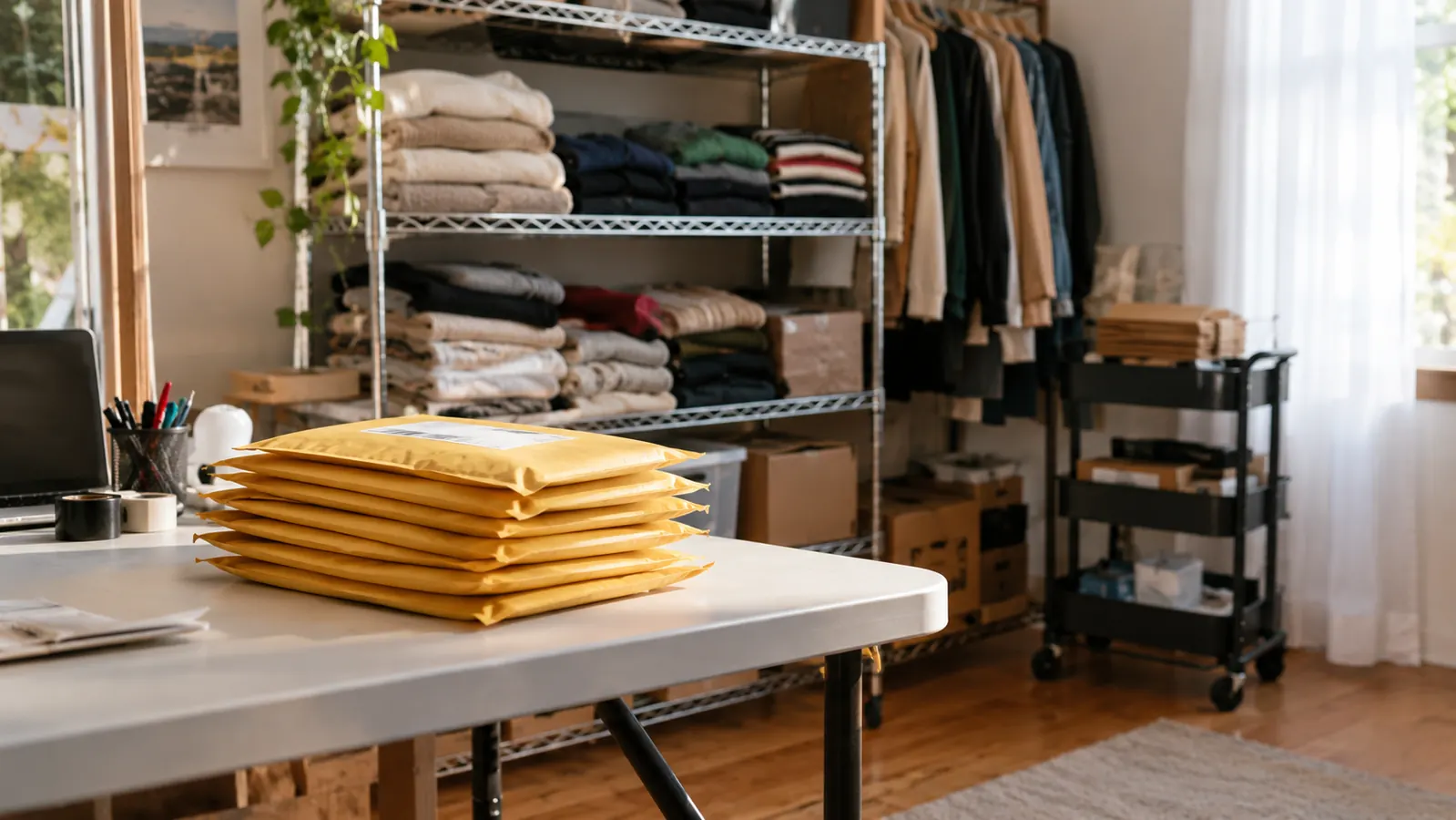
The spare bedroom in my house has not been a bedroom for years. It holds a folding table, wire shelving stacked with thrifted inventory, and a rolling cart that carries whatever is going out that morning. I have packed eBay and Poshmark orders in that room for about six years. The single change that saved me the most time was moving most of my soft goods out of boxes and into padded envelopes. Fuxury bubble mailers are what I keep on the shelf now, in the 12x15 size, and I buy them a pack of 25 at a time.
This is not a paid endorsement and it is not a pitch about getting rich on thrift store finds. It is a list of the ten specific things a padded mailer does for me that a box does not, written by somebody who learned most of them the hard way. I will also tell you the three jobs I still refuse to put in one.
The envelope that retired half the boxes in my packing room
12x15 usable space inside, a 12x16 outer, self-seal closure, polyethylene shell. It is the size I reach for first on most mornings.
Amazon Check current price on Amazon →The bubble layer takes knocks a flat poly mailer passes straight through
A plain poly mailer is a plastic bag, and when it gets dropped in a sorting bin the contents take the whole hit. This one has a layer of bubbles bonded to the inside, so a hardcover book with a sharp corner arrives without a mashed corner and a folded sweater arrives without a snag. Two winters ago I shipped a hardcover cookbook in a flat poly mailer to save a few ounces of postage. The buyer sent me a photo of a crushed spine corner, and I refunded the order and ate the shipping both ways. That was the last book I ever sent flat. I still box glass and anything genuinely fragile. For clothing, books and small non-fragile housewares, the padding covers the trip.
The self-seal strip removes a step from every single package
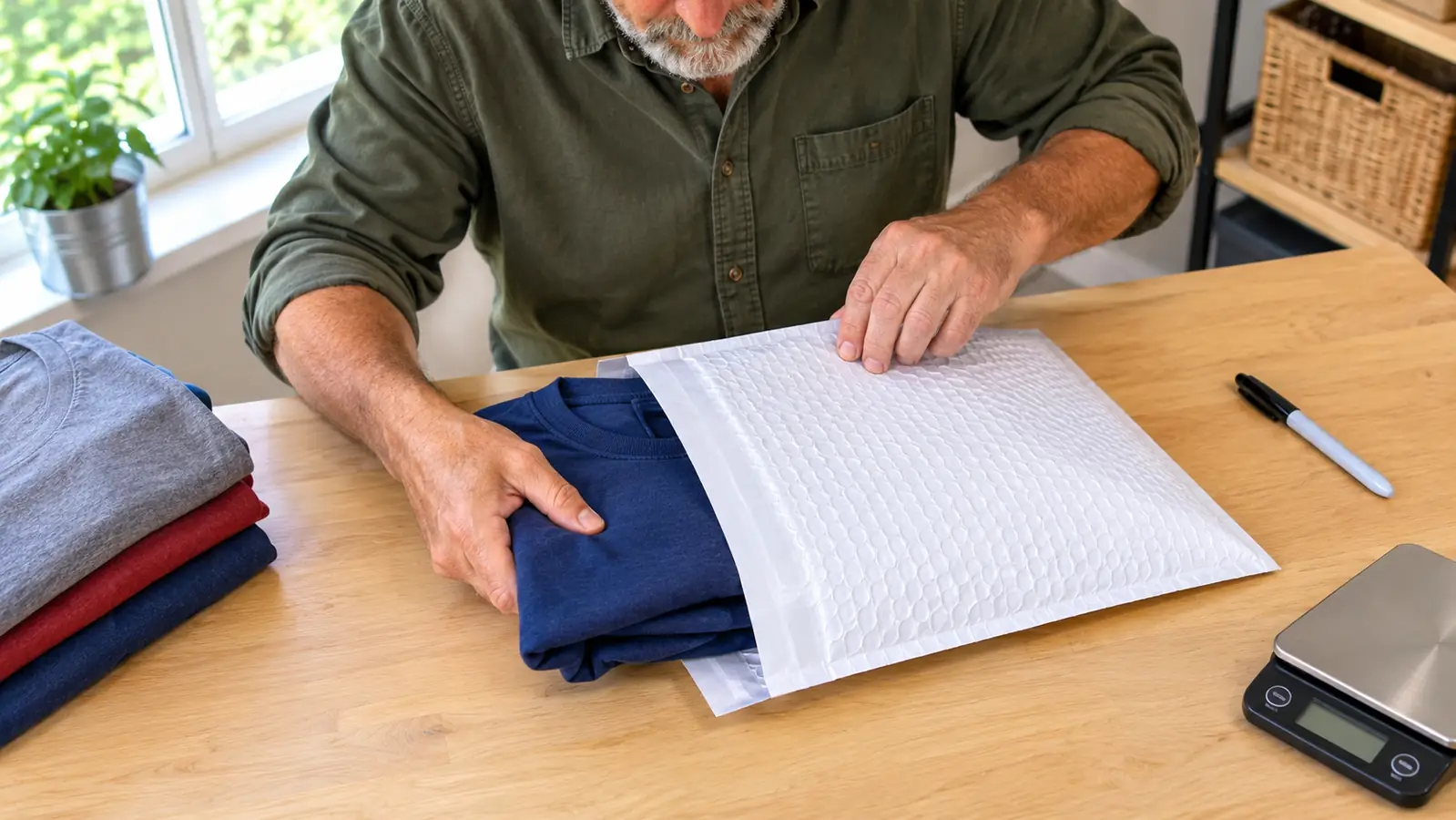
The closure is an adhesive strip under a peel-off liner. Pull the liner, fold the flap down, press it flat. No tape gun, no sponge, no water bottle. On a Saturday morning in November I packed fifteen orders before nine o'clock, and that count is only possible because there is no tape step in the middle of it. Fifteen packages times two passes with a dispenser is a real amount of hand motion, and my hands notice by the second hour. On heavier items I still run a strip of tape across the seam, mostly out of habit.
12x15 inches swallows the odd shapes my boxes fought with
The outer measures 12x16 and the usable space inside is 12x15. That is enough for a pair of ankle boots, a stack of three paperbacks, a folded quilt, or a chunky knit sweater with room to spare. I keep the Fuxury stack at the near end of the table so I am not reaching across a half-packed order to get one. The rectangular shape means nothing has to be forced into a corner. It fits or it does not, and when it fits it packs in seconds instead of minutes.
The polyethylene shell takes a scrape without splitting open
The outer material is polyethylene, which is the same family of plastic that makes a good poly mailer tough. It slides along a conveyor instead of catching, and it shrugs off the corner scrapes that tear a paper envelope. I have had one split in six years. That one carried a framed print with a hard plastic corner pressed right against the edge and nothing wrapped around it, and it opened along the seam somewhere in transit. The envelope was not the problem in that case. My wrapping was.
One size covers most of what I list, so packing stops being a sorting job
I used to keep three box sizes and stand there guessing which one a sale needed. Now the Fuxury stack handles nearly everything that is not breakable. The decision is gone. I pull an envelope, fold the item, seal it, and move to the label. Fewer decisions in a morning means fewer mistakes, and mistakes are what cost you a return. I still keep two small boxes on the bottom shelf for the exceptions, but I reach for them maybe twice a week.
They store flat, which matters in a room that has to do two jobs
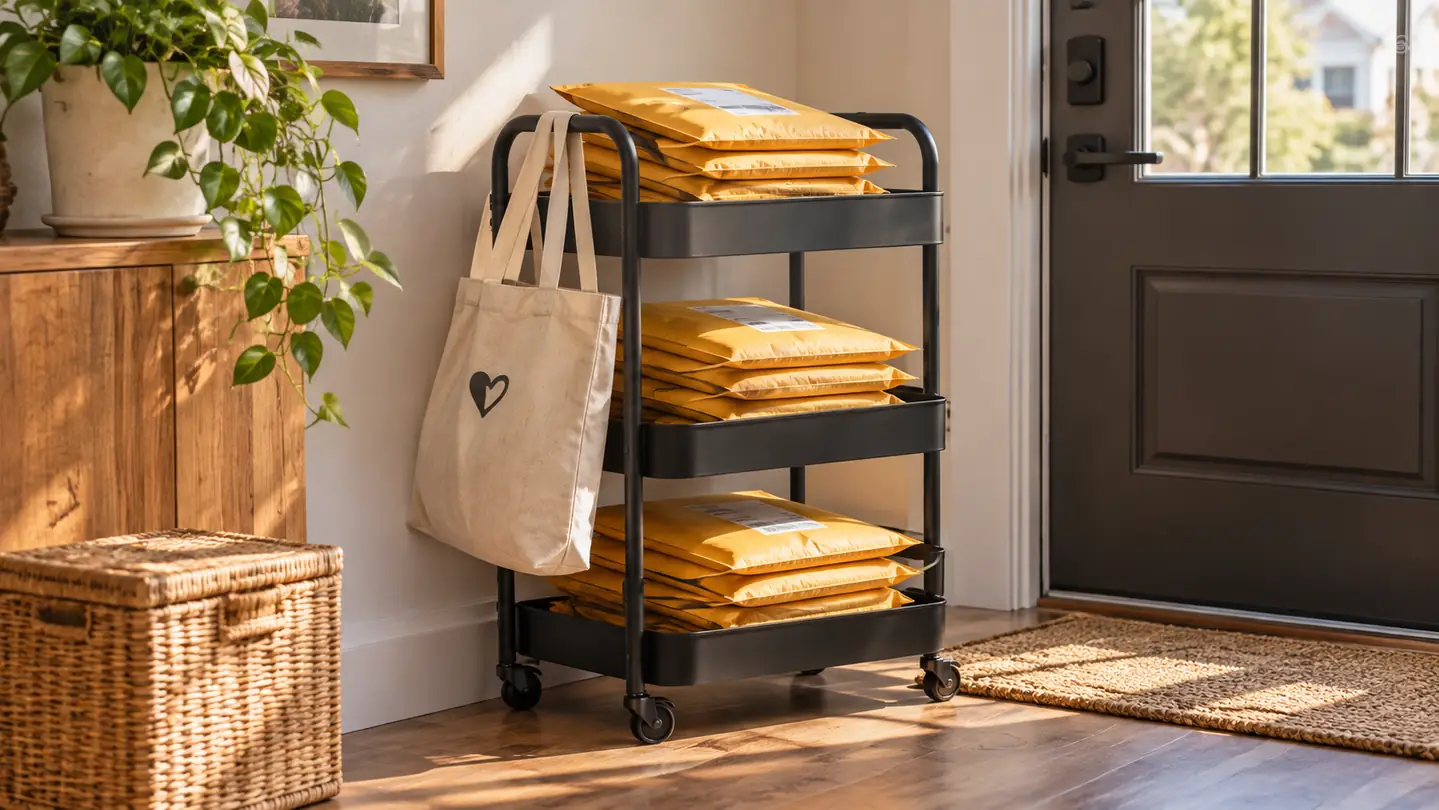
A pack of 25 lies flat as a magazine. Mine lives upright between the shelving upright and the wall, where it takes up about an inch of width. Boxes had to be broken down flat or stacked in a corner, and the stack always fell over. For a while I kept flattened boxes behind the door, and one of them slid down one afternoon and took a mug with it. In a spare bedroom that also has to hold inventory, an inch of storage is real estate.
Lighter parcels mean fewer trips with the heavy cart
A padded envelope weighs a fraction of a box plus paper fill, and the difference adds up across a morning's worth of orders. My husband Gary carries the tubs to the post office drop-off for me. He is the one who noticed first. His words were that the tub felt lighter than it used to, and he was right, because half of what was in it had become envelopes instead of boxes. My own back notices it too, on the days I load the rolling cart myself.
I get fewer arrived-damaged messages, and those messages eat an evening
Every damaged claim is a message, a photo request, an apology and sometimes a return, and all of it lands in the hour I had set aside for listing. Since I moved soft goods into padded envelopes, that category of message has mostly stopped. Not entirely. A buyer who expects a box will occasionally write to ask why a sweater came in an envelope, and I answer that one with a single sentence. Fewer problems is not the same as more money. It is simply less of my evening gone.
No tape, no void fill, no hunting for the dispenser
A box needs tape on three seams and something inside to stop the contents sliding around, and both of those live somewhere on the table until they do not. The padded envelope needs neither. My folding table is now clear except for the scale, a marker and the stack of mailers. A clear table is the difference between packing being a task and packing being a chore, and chores are the things that get put off until the afternoon.
A soft item in a padded envelope looks like a shop, not a closet
A sweater stuffed into a reused box with paper showing at the seams reads as amateur, and buyers read it that way in the listing photos and again in the unboxing. A padded envelope that closes square and flat looks intentional. It costs me nothing extra in effort, and it is the version of my packing I am not embarrassed by. Six years in, that still matters to me more than the time saved.
The outer measures 12x16 and the usable space inside is 12x15. That inch is the difference between a pair of boots fitting and a pair of boots being forced.
What I'd Skip
Three jobs still go in a box, and I would not talk you out of that. Anything glass, ceramic or genuinely fragile gets a box with padding on all six sides, because a bubble layer protects against knocks and not against a sorting bin landing on a corner. Anything with a sharp point that can press against the shell gets wrapped first or boxed, since a hard corner under pressure is how envelopes fail. And nothing liquid goes in one, no exceptions. I would also say this plainly: if you ship six packages a month, a pack of 25 Fuxury mailers will last you the better part of a year, and that is fine. Buy one pack, see how the size fits what you actually sell, then decide.
Start with one pack of 25 and see what stops fitting in a box
12x15 usable space, 12x16 outer, self-seal, polyethylene. The size I reach for before I reach for anything else.
Amazon Check current price on Amazon →