
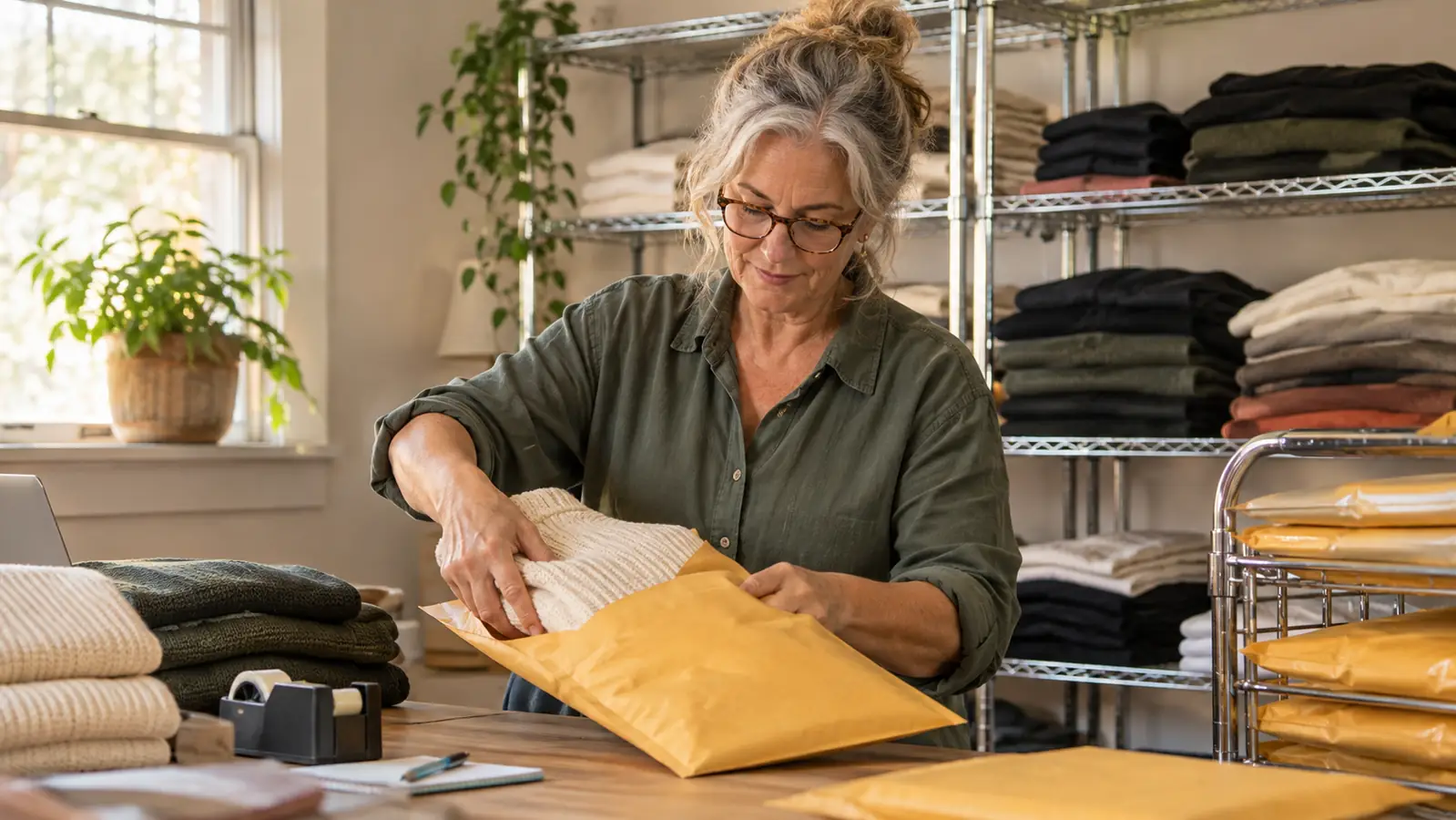
The first box of Fuxury bubble mailers I bought sat on my wire shelving for nine days before I cut it open. Not because I did not need mailers. I had three Poshmark orders waiting and nothing to send them out in. I stalled because I have been burned before by a cheap pack that turned out thin, gummy at the seal, and about an inch smaller than the listing claimed. So I opened that box expecting to be annoyed, with a sweater already folded on the folding table and a backup flat poly mailer within reach.
I was not annoyed. That is the short version, and if the short version is all you want, the verdict block is a few lines down. What I owe you is the longer one, because a mailer is a small purchase that causes a large amount of grief when it is wrong. Some context on me. I am Teresa Vance, fifty eight, retired from a school office and now selling thrifted clothing, housewares and books part time out of the spare bedroom in Dayton, Ohio. Six years of this, mostly eBay and Poshmark with a little Mercari mixed in. Most mornings I am at that table packing. A padded mailer either makes that hour easier or it stretches it out, and after four packs of the Fuxury 12x15 I can tell you which one this is.
The Quick Verdict
A padded mailer that does the boring things right. The seal holds, the usable inside matches the stated size, and the pack is consistent. It is not a box, so keep one on the shelf for anything with glass in it.
Amazon Check Today's Price →The mailer I stopped comparison shopping for
Self-seal closure, 12x15 usable space inside, 25 to a pack. Four packs in and I reorder this one without rereading the listing.
Amazon Check Today's Price on Amazon →What I Actually Use These For
Most of what leaves this house is soft. Sweaters, jeans, dresses, the occasional pair of boots. That is the obvious use for a padded mailer and it is the use nobody needs a review for, because almost anything works. The orders that actually test a mailer are the middle ones. A paperback, a small ceramic bowl, a set of vintage coasters, a glass candle jar that somebody paid more for than I expected. Those are the shipments where a bad decision at the packing table shows up two weeks later as a message from a buyer.
A folded sweater in a flat poly mailer arrives fine. Nobody has ever messaged me about one. A paperback in a flat poly mailer arrives with a bent corner roughly one time in five, and that is a partial refund or a three star review that says the item was as described but poorly packed. That review follows the listing around for years. A padded mailer mostly ends the problem. It cushions one face and two edges, which is enough for a book and nowhere near enough for a teacup.
Where these earn their place is the range that is too bulky for a flat poly and not fragile enough to justify a box and the postage a box usually brings with it. That is most of my inventory. On a normal week, maybe sixty percent of what goes out could ride in one of these and arrive exactly as it left. The rest goes in a box, and I have stopped feeling bad about that. One package type for everything is a fantasy that costs you money in damaged goods.
The Size Numbers Are the Whole Story
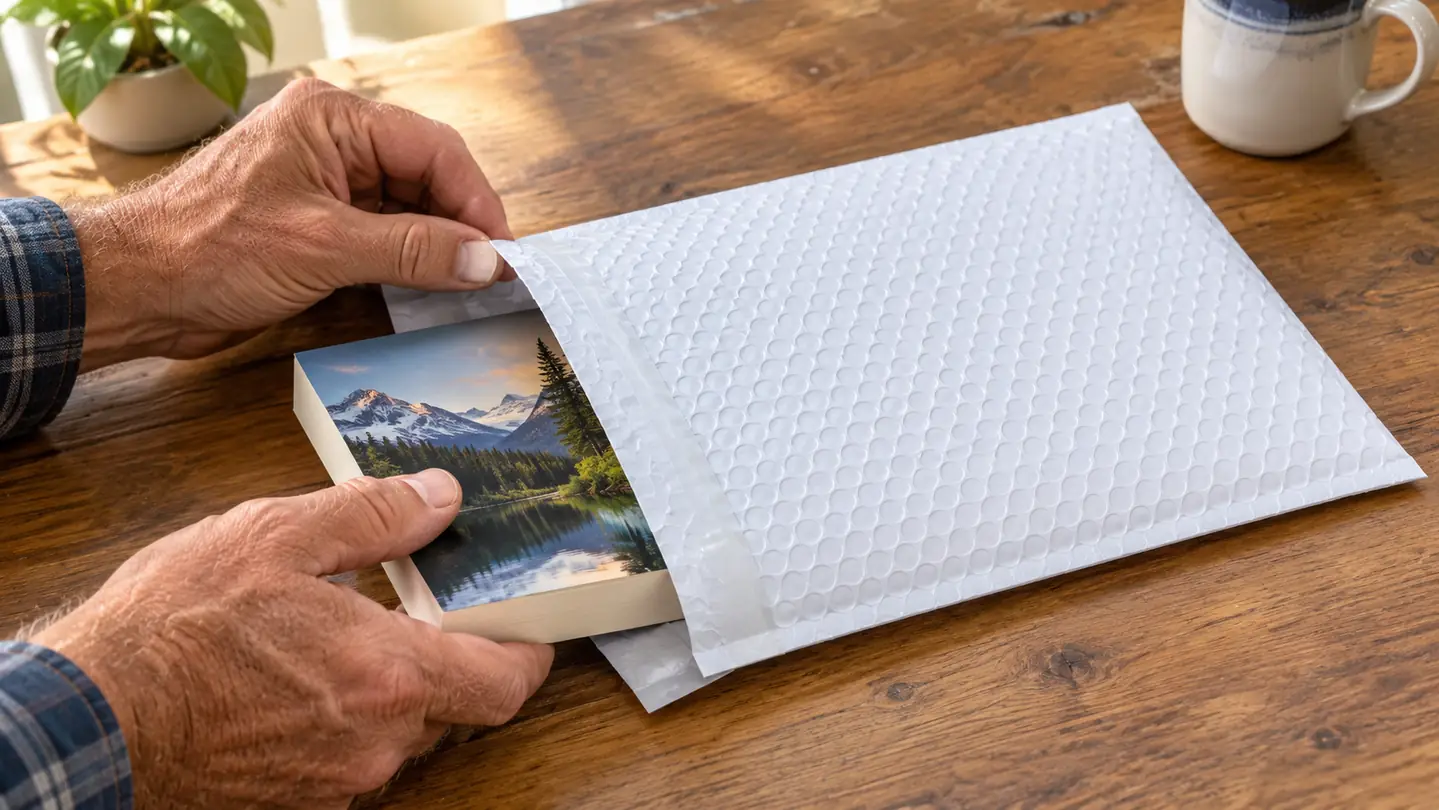
Here is the thing that trips people up, and it tripped me up on my very first order. The listing says 12x15. The outer measurement is 12x16. The usable space inside is 12x15. Those are two different numbers, and the gap between them is the seal strip plus the edge, and the gap is not negotiable. You cannot stretch it and you cannot trim it.
That gap matters the moment you cut a stiffener. If you cut a 12x15 piece of cardboard to keep a shipment flat, it will not slide past the seal. I found that out with a lot of five vintage postcards and a pair of scissors and a growing sense of foolishness. I now cut backing boards to 11.5 by 14.5 and they drop in clean with a quarter inch of padding all the way around. If you buy these, buy them knowing you will trim your stiffeners down a little. It is a five minute adjustment and then it is permanent.
I cut my backing boards to 11.5 by 14.5 inches and they drop in clean. A 12 by 15 board simply will not slide past the seal.
The other number that matters is thickness, and nobody lists it anywhere. These are not flat sleeves. Once you have a folded sweater and a layer of tissue inside, the package has real depth, and the seal has to stretch across that depth. If you are stuffing to the point where the flap has to fight its way over the top, you have bought the wrong size and you will find out about it at the worst possible moment. Size up for anything over an inch thick. A mailer that is a little large costs you nothing in postage and saves you a seam that lets go inside a sorting facility.
How They Held Up Over Four Packs
I have worked through four packs of the Fuxury mailers since that first box, so somewhere north of a hundred packages at this point. Consistency is the thing I care about most now, more than any single feature. A pack where the first ten are good and the last ten are thin is worse than a pack that is merely average the whole way through, because you cannot plan around a product that changes halfway down the box.
Across those four packs I have not found a bad one. The bubble layer is even, corner to corner, with no flat spots along the fold lines. That sounds like a small thing until you have had a mailer arrive with two dead channels running down the middle, which is the same as having no padding at all in exactly the place your item sits. I check the first two out of every new pack now. So far it has been wasted effort.
The flap adhesive has been the same every pack. Same pull, same stick, same clean peel. If you have ever opened a box of mailers and found the peel strips cut short at one end, you know why I keep mentioning it. That defect makes an entire box useless because you are back to packing tape and a bad attitude. I have not hit it here, not once in four packs.
The Seal Is Where Most Mailers Fail
Self-seal closures are not interchangeable, whatever the listings imply. Some peel strips fight you and tear down the middle. Some are so aggressive that the second the adhesive touches the other side it is committed, and if you are off by half an inch you are looking at a wrinkled flap and a package that looks like it was packed in a hurry. It probably was.
These peel cleanly and press down flat. In four packs I have not had a strip tear off in a ragged line, which was close to a weekly event with the discount packs I used to buy locally. That is the entire benefit and there is nothing clever about it. The closure does what a closure is supposed to do, on a Tuesday morning, when you are trying to get fifteen packages out the door before the carrier pulls up.
Two habits worth building no matter whose mailers you buy. Press the seam with your thumb the full length, corner to corner, because the corners are what lift first. And never fold the flap over your item to test the fit before you seal. Once it touches, it is sealed. I have wasted three mailers learning that and I expect to waste a fourth sometime this year.
What They Save You, and What They Do Not
The time math is the honest reason I keep buying them. A box takes me ninety seconds to build, fill, tape and label. A padded mailer takes about twenty five. On a morning of fifteen packages that is roughly a quarter of an hour back, plus one less roll of tape, and the quarter hour is the part that matters when my back is already complaining about the height of that folding table.
What they do not save you is sorting. You still have to keep sizes straight, and if you keep two mailer sizes on the shelf you will grab the wrong one at least once a week until you label the shelf. I use a strip of masking tape with the size written on it in marker. Not elegant. It works, and it took me a shamefully long time to think of it.
And the cushioning is not the same as a box, no matter what the listing photographs suggest. Anything with glass, a handle, a ceramic foot or a hard corner still goes in a box with paper. I keep a shelf of those for exactly this reason. A padded mailer is a good tool that solves a specific problem, and the trouble always starts when you ask it to solve a different one.
Two Things I Tried Before These
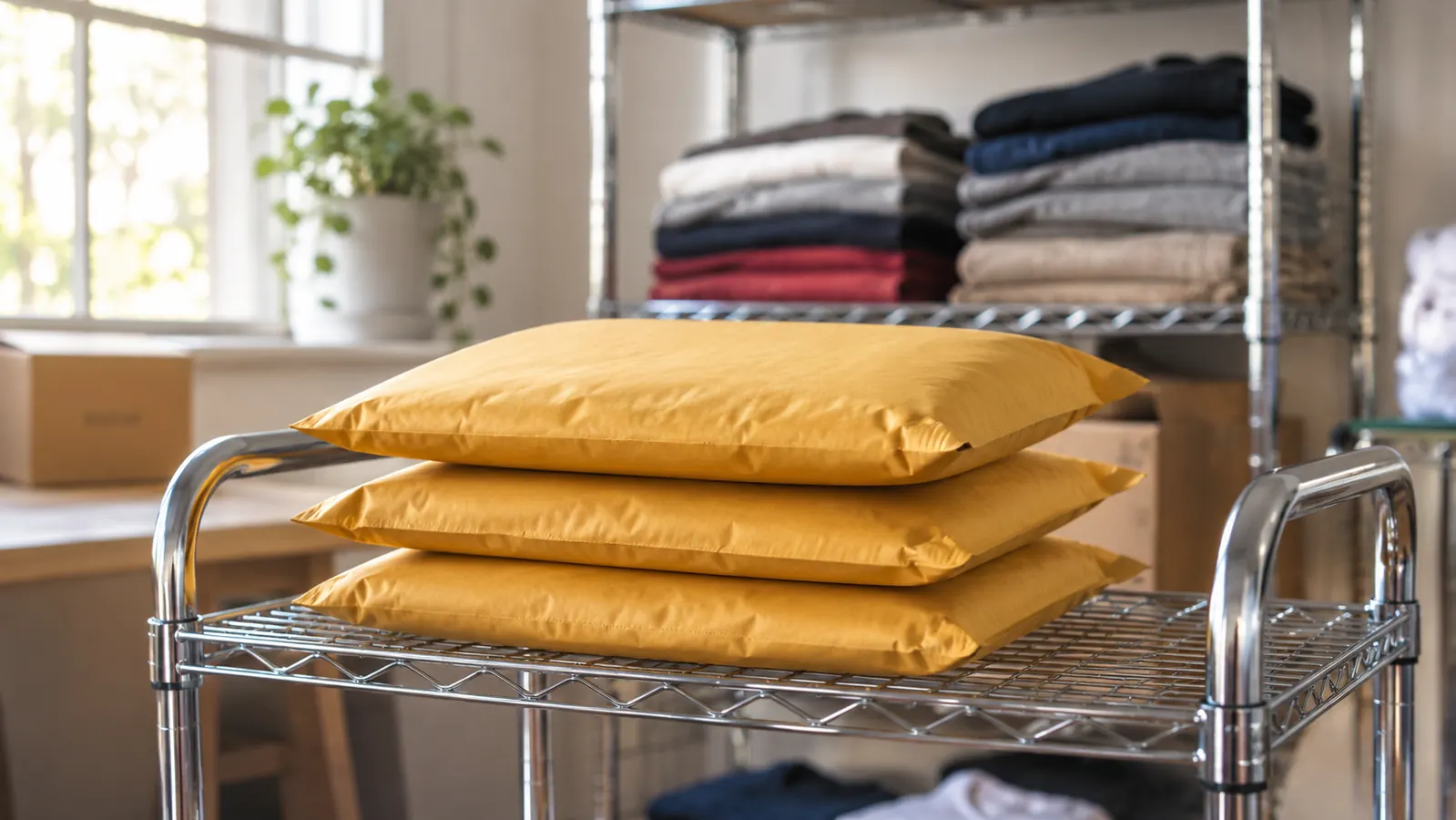
Before I settled on these I spent about a year with two other options. The first was flat poly mailers, which take less shelf space and are fine for soft goods but useless for books. I got tired of wrapping paperbacks in cardboard like a school project. The second was boxes for everything, which was overkill, slow, and pushed several of my lighter packages into a shipping tier they did not need to be in.
The padded mailer sits between those two and that is the whole argument for it. Flat poly for a sweater, padded mailer for a paperback or a small bowl, box for anything breakable. Three package types on the shelf and the decision takes two seconds instead of a minute of standing there weighing it. I name Fuxury only because that is the one that ended up living on my shelf. The category itself is not complicated.
What Nobody Tells You: The Parts That Annoy Me
First annoyance. Twenty five to a pack is a lot of shelf space if you sell slowly. The box is not enormous, but it is not nothing either, and if you ship four items a week you will be moving that same box around for months. That is a volume problem rather than a product problem, but it is worth knowing before you order two packs to save yourself a trip.
Second. Once these are sealed, they are sealed. A buyer cancels an order or asks for a different address after you have already packed it, and you are cutting the mailer open and starting over. There is no gentle reopen. I have tried. The flap comes away with the top layer of the mailer attached and you are not reusing it. Keep one spare of each size loose on the cart for exactly this.
Third, and this is the one that actually cost me an order. A hard edge will eventually find its way through the bubble layer. A picture frame corner with no padding around it punched clean through the face of a mailer in transit. The item survived and the buyer was gracious about it, but I now wrap any hard corner in a strip of bubble wrap before it goes in. That is a small extra step I did not expect to need. It is the tradeoff of a soft package, not a defect in the mailer.
What I Liked
- Self-seal closure peels clean and stays down, corner to corner
- Usable inside measures the stated 12x15, with a 12x16 outer
- Consistent across four packs, no dead channels in the bubble layer
- Saves tape and about a minute per package compared with a box
- Enough padding for paperbacks, folded garments and small housewares
- 25 to a pack means fewer reorders
Where It Falls Short
- Not a substitute for a box on glass, ceramics or anything with a hard corner
- Once sealed, it cannot be reopened without destroying the mailer
- A full box takes real shelf space in a small packing room
- Sharp edges can work through the padding in transit
- Outer size runs an inch larger than the number in the listing title
Who This Is For
If your inventory is clothing, books, fabric, small soft housewares or anything that lands in the middle zone between a flat poly and a box, the Fuxury 12x15 is the size I would start with. It suits a home reseller shipping a handful to a few dozen packages a week out of a spare room, and it suits anyone who has gotten tired of hunting for the tape gun every morning. If you are on the fence between this and one size larger, go larger. You can always add padding, and you cannot unseal a flap.
Who Should Skip It
Skip these if you sell glass, ceramics, lamps, framed art, or anything else with a hard corner and a bad attitude. Skip them if you only ship a few packages a month, because twenty five will outlast your patience and your shelf. And skip them if you are looking for one package type that handles everything, because there is no such product, and pretending otherwise is how a mug arrives in three pieces with a note from the carrier.
Four packs in and I still reorder the same one
Self-seal closure, 12x15 usable space inside, 25 to a pack. Check today's price and keep a box on the shelf for the fragile stuff.
Amazon Check Today's Price on Amazon →